

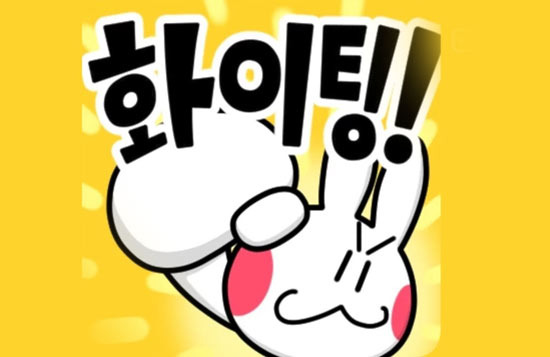
Many people are under the misconception that the term "Fighting" has been a traditional ethnic cheer since the Joseon Dynasty.
Grandmothers use it, elementary school students use it, and in the military, you hear it a thousand times a day.
But in reality, it has a surprisingly short history.
It is a newcomer word that is only a few decades old.
Its birthplace is not during the Joseon Dynasty or right after liberation, but simply in the 1960s and 70s.
And the funnier thing is that it comes from the English word fighting. What does fighting mean in English?
Punching, fighting, hitting, grabbing someone by the collar—that kind of fighting.
If someone says "Fighting!" to a friend before an exam in English,
the foreigner might think, "Why are you telling me to fight?"
But the moment it enters Korea, the meaning of this word completely changes.
"Let's do well."
"Let's hang in there."
"Let's go all the way."
This is a successful case of Korean-style rebranding.
This term began to spread widely in the early 70s. Factories were being established, military and university cultures were solidifying, and events like sports competitions were booming. It was a time when people had to come together to do anything.
During this time, the military and sports culture made a significant impact. With the emergence of chants, group cheers, and cheering culture, "Fighting" began its nationwide tour.
From the mid-70s, as TVs became common in households, "Fighting" was shouted everywhere—from sports events to school functions, company sports days, and entertainment programs.
The masterpiece that emerged at this time was "Aja Aja Fighting." With the rhythm completed, by the 80s, it became a national cheer.
The reason this phrase resonated so well was that it matched the times perfectly.
The atmosphere in Korean society at that time was one of economic growth, exam wars, job wars, military service, long working hours—essentially, the entire nation was in a survival game.
In such a society, saying "Hang in there" felt too lofty.
"Fighting" was just right.
Short, strong, intuitive, and energetic. This one word encompasses "endure, push, don't give up."
However, the moment this word crosses borders, it causes confusion.
When you say "Fighting" to foreigners, most of them do not understand.
In English, fighting does not mean cheering.
Yet for Koreans, it has now become a purely Korean word.
It originated from a foreign language but has been thoroughly naturalized and lives like a Korean word.
In summary, the history of "Fighting" is at most just over 60 years.
But in that short time, it has become a symbol that encompasses the competition, tenacity, collective culture, and growth story of Koreans.
So even now, we simply use this word.
Because this one phrase contains the unique life philosophy of Koreans.






 fortbliss |
 Folding Instructions |
 yentra |
 Cali M Law Group |
 quanta7 |
 Eldorado 88 |
 Washington Monument |


 heartbreaker |
  Korean Mom |
  My NYC |
  moo moo |
  Mr Oh |
  forevergee |
  festival |
  manchester |
  constant |
  Leapfrog Move |
  vibranto |
  Tora Tora |
  yellowbutter |
  Dolly |
  US Embassy |
  NYC saladbar |
  Finding Superfoods |
  lightyear |
  song bang |
  vexomo |
  Indiana Jones |