

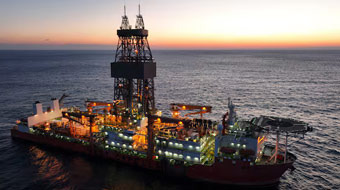
On June 3, 2024, President Yoon Suk-yeol announced during his first national briefing after taking office that there is a high possibility of significant oil and natural gas reserves being buried off the coast of Pohang. This announcement was based on a physical exploration deep analysis conducted by a world-class deep-sea technology evaluation company, following the judgment that there is a high likelihood of more oil and gas fields around the East Sea gas field, made last February. According to this analysis, experts have verified that there is a very high possibility of up to 14 billion barrels of oil and natural gas being buried.
President Yoon Suk-yeol informed the press at 9 a.m. on the day of the announcement, without revealing the subject of the announcement, and the actual announcement was communicated just 8 minutes before the national briefing began.
Broadcasters were busy preparing for the live broadcast, and when the briefing time arrived, the president left after a brief announcement of about 4 minutes without taking questions. The Ministry of Trade, Industry and Energy explained this as a matter 'decided by the presidential office,' and Minister Ahn Duk-geun stated that he only learned that he was attending the national briefing that morning.
In this announcement, President Yoon Suk-yeol presented the estimated reserves ranging from a minimum of 3.5 billion barrels to a maximum of 14 billion barrels, estimating that about one-quarter of this would be oil and three-quarters would be natural gas. He stated that the value of these resources, based on the maximum reserves, amounts to approximately 2,260 trillion won, which is five times the market capitalization of Samsung. Additionally, he mentioned that this reserve holds more resources than the 11 billion barrels of the Guyana field, which is considered the largest oil development of the 21st century. For reference, Saudi Arabia's oil reserves were approximately 297.5 billion barrels as of 2020.
This announcement was expected to be a significant turning point that could greatly impact Korea's energy security and economy; however, with the complete cut of the budget related to the Great Whale Project in the 2025 budget proposal, the project has effectively been halted. As a result, the government has been unable to secure the necessary funds for the project, and the Korea National Oil Corporation has found itself in a situation where it must secure funding independently. However, the oil corporation is facing difficult financial conditions, making it challenging to issue corporate bonds and secure funds.
In this regard, President Yoon Suk-yeol mentioned in a public address that the National Assembly's budget cut for the Great Whale Project was one of the reasons for declaring martial law. In contrast, the opposition party, the Democratic Party, rebutted that the necessity of the project budget was not substantiated due to a lack of long-term planning, feasibility assessments, and insufficient submission of specific data.
On February 2, 2025, Actgeo submitted a report to the Korea National Oil Corporation stating that it had newly discovered 14 promising structures in the Ulleung Basin area where gas and oil are likely to be buried. Among them, the 'Devil Shark' area is estimated to have up to 1.29 billion barrels of gas and oil.
On February 4, 2025, the first exploratory drilling of the Great Whale Project was completed, and unless there are significant changes, the analysis results are expected to be announced between May and June. However, on February 6, 2025, the Ministry of Trade, Industry and Energy stated regarding the Great Whale drilling results that "there were some tentative signs of gas, but the scale was not significant and did not reach an economically viable level." However, it was confirmed that the geological structure was favorable, and plans were announced to conduct additional exploration in other promising structures in the Ulleung Basin area, including 'Devil Shark,' 'Squid,' and 'Mackerel,' through foreign investment attraction.
During this process, the Ministry of Trade, Industry and Energy apologized, stating that "political influence was involved," which is interpreted to mean that the political judgment of the presidential office had a greater impact than objective evaluations such as the economic viability of oil drilling. This has raised critical voices, pointing out that the government presented rosy prospects without sufficient verification and wasted about 100 billion won.
The oil corporation decided to secure about 400 million dollars (approximately 570 billion won) through new loans as part of its 2025 funding plan, but as uncertainties regarding the future development of the project increase, additional economic burdens are expected.





 Korean Mom |
 novapixel |
 Peter Pan Pet |
 horse |
 Sunset Oregon |
 Weekend Movie Blog |
 Beauty, Health, Lifestyle Blog |
 coloradoman |
 Superman Cat Blog |
 dralix58 |
  Gorama Round |
  Skydiving |
  dreamport |
  Yellow Snowman |
  Toaster Pizza Magic Show |
  velvetnom |
  Anytime Journey |
  Mrs. Duluth |
  jaxter |
  Atlanta Mama |
  Baguette Blog |
  US Embassy |
  My NYC |
  moo moo |
  Mr Oh |
  forevergee |
  festival |
  manchester |