

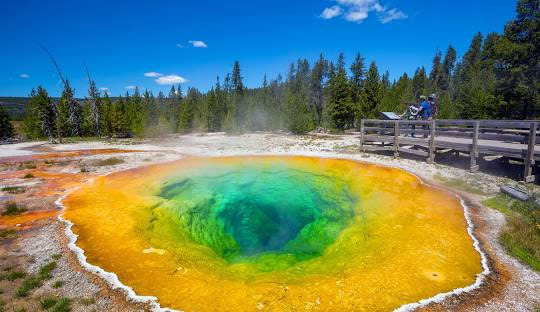
Yellowstone National Park is simply one of the most famous natural tourist destinations in the United States and even the world. It was designated as the world's first national park in 1872, and it is well known not only for its historical significance but also for its breathtaking natural scenery. Yellowstone covers a vast area spanning the states of Wyoming, Montana, and Idaho, boasting a massive area of 2.2 million acres.
Yellowstone was originally an important land for Native Americans. Various indigenous tribes lived in this area for thousands of years, coexisting with nature. In the early 1800s, as Europeans began to explore the American continent, Yellowstone was first recorded. Among them, a figure named John Colter explored the Yellowstone area around 1807 and reported on the unique natural phenomena of the region.
Significant interest followed the explorations of George Marsh and William Henry Jackson. The photographs and records they captured made Yellowstone an official focus of interest for the U.S. government in the late 1860s. Ultimately, on March 1, 1872, a valid bill was passed designating it as the world's first national park. Yellowstone was the first national park created by the U.S. government to protect nature and ensure public access.
This area includes the largest supervolcano in the world.
The volcano in Yellowstone was one of the largest volcanic eruptions in U.S. history, and its explosive power far exceeded what we can imagine today. The resulting Yellowstone Caldera is a world-renowned site and an important subject of volcanic research.
This caldera is so massive that it spans approximately 30 miles (about 48 kilometers), and geothermal activity is currently very active in this area. Yellowstone is rich in geothermal features, hot springs, and geysers.
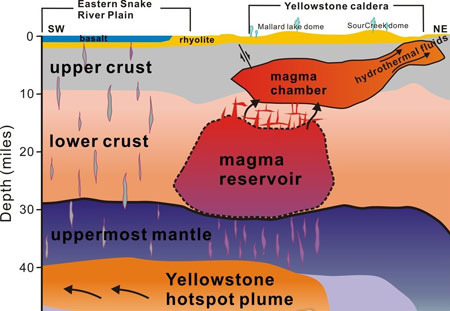
Below Yellowstone National Park lies the largest supermassive magma reservoir in the world. This signifies the presence of a supervolcano beyond simple geothermal activity. This supervolcano is one of the most powerful natural disasters imaginable in human history, with explosive power that could have catastrophic effects worldwide.
Overview of the Yellowstone Supervolcano
The Yellowstone supervolcano is one of the largest volcanoes on Earth, with the potential to cause large-scale volcanic eruptions. Its size is in the form of a massive caldera (the crater left after a volcanic eruption) that exceeds approximately 2,400 km² (about 1,000 square miles), and the magma reservoir within this area is still active. It is estimated that this magma reservoir holds about 2,000 km³ of magma, making it one of the largest magma reservoirs on Earth.
The magma reservoir in Yellowstone exists deep underground, located between the Earth's mantle and crust. This magma has caused several large-scale eruptions in the past, occurring approximately 640,000 years ago, 1.3 million years ago, and 2.1 million years ago. Each eruption was an unimaginably large natural disaster that drastically changed the local environment and had significant global impacts.
This magma reservoir is still active, and scientists are trying to predict the potential eruption of the supervolcano through geothermal activity, minor earthquakes, and changes in geysers in the area. However, it is still uncertain when the supervolcano will erupt, and estimates suggest that it could be thousands or millions of years away.
The Risks of a Supervolcano Eruption
If the Yellowstone supervolcano were to erupt, the consequences would be immense. The volcanic ash and gases released during the eruption could spread into the Earth's atmosphere, causing climate change. In particular, gases such as sulfur dioxide that this volcano could emit could lead to a "volcanic winter," drastically lowering the Earth's temperature, which would significantly impact agricultural production worldwide, leading to famine and food shortages.
Additionally, the earthquakes and volcanic eruptions caused by the explosion could result in large-scale infrastructure destruction and massive fires. This would likely lead to significant loss of life and economic damage, as well as catastrophic effects on ecosystems worldwide. Furthermore, if sunlight is blocked due to climate change and volcanic ash, the changes in climate could become severe, lowering the Earth's average temperature.
Eruption Cycles and Warning Signs
The Yellowstone supervolcano is currently very active, but scientists find it difficult to predict when an eruption will occur. The eruption cycle of a supervolcano happens over millions of years, so eruptions occur at very long intervals. According to current research, the magma reservoir in Yellowstone shows consistent geothermal activity, and changes in geysers or minor earthquakes indicate active geothermal activity in the area.
However, it cannot be assured that these changes will lead to an eruption, and scientists are trying to detect future eruption risks through the movement of magma and seismic activity.
Yellowstone is home to various natural attractions:
Old Faithful: As mentioned earlier, this is a geyser that erupts hot water at regular intervals. It is very popular among visitors because it always erupts at a set time, often leading tourists to wait in long lines to witness the spectacle.
Grand Prismatic Spring: This hot spring boasts truly amazing colors. The beautiful sight of blue, green, and yellow layers is one of the most photographed scenes in Yellowstone.
Grand Canyon of the Yellowstone: This is a deep canyon through which the Yellowstone River flows. The waterfalls within the canyon are truly spectacular. The water cascading from a waterfall the size of a baseball field leaves a deep impression on visitors.
Northern Headwaters: This area is a place to observe the beauty of nature and ecosystems, home to various wildlife. It is also a place where grizzly bears, gray wolves, and white-tailed deer are frequently spotted.
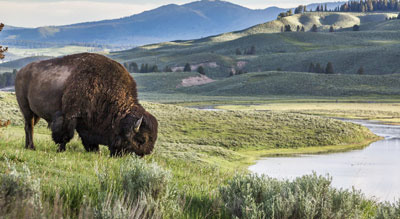
Yellowstone has a well-preserved natural ecosystem, allowing for encounters with various wildlife. Grizzly bears, gray wolves, and American bison are among the many animals that inhabit this area. Additionally, the region is home to many birds and fish, making it an ideal location for wildlife observation enthusiasts.
Yellowstone is a place of geological significance, natural beauty, and a well-balanced ecosystem, making it a must-visit destination for nature lovers.







 Baguette Blog |
 Khan Film Blog Production |
 dermoon |
 hoosierdaddy |
 sun walker |
 Childbirth Drabble Blog |
 tarvion |
 velaro |

 laro90 |
  MEDBIO American Doctor Blog |
  SWAT TEAM BLK |
  DREAM BIG |
  frostbite |
  330 Forever My Love |
  El Dorado |
  dralix58 |
  Gorama Round |
  Skydiving |
  dreamport |
  Yellow Snowman |
  Toaster Pizza Magic Show |
  velvetnom |
  Anytime Journey |
  Mrs. Duluth |
  jaxter |
  Atlanta Mama |
  Tan Sol |