
Last week, the son of a family I know brought a notice about their insurance renewal. It's a personal insurance plan obtained through Obamacare, and they said the premium is going up significantly next year.
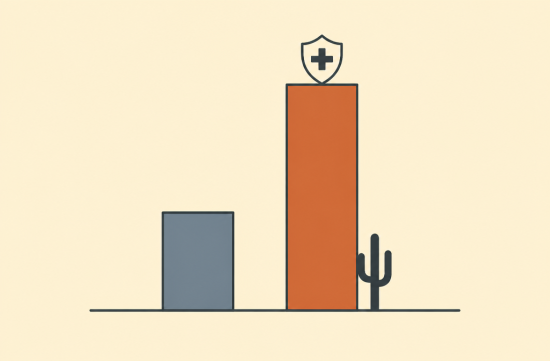
It turns out this isn't just an issue for that family. The entire Arizona individual insurance market is set to rise sharply next year, reaching the highest levels in the nation.
First, let's break down the numbers. The rate increase applications submitted by insurance companies to the state government this spring for 2027 were around a weighted average of 29%. Both healthinsurance.org and ACASignups reported the same figure.
But that's not all. ACASignups reported on October 22 that the final approved rates were released. The confirmed average increase for the individual market is 27.9%, which is slightly lower than the application figure.
Even if it's a bit lower, that's still not a small number. The national median application increase is about 15%, so Arizona's is nearly double that. It's surprising, isn't it? I thought only the desert heat was the highest in the nation, but it turns out insurance premiums are too.
Looking at the differences by insurer, there's quite a range. Based on applications, Oscar had the highest at 33.9%. Blue Cross Blue Shield of Arizona was at 29.6%, and UnitedHealthcare was at 28.6%.
Arizona Complete Health, part of Health Net, was around 24.6%. In contrast, Antidote stood out with a much lower rate of 3.3%.
The number of insurance companies has also decreased. Cigna is exiting the individual market by the end of this year, leaving only six companies for next year. Cigna enrollees must choose a new plan during this open enrollment period.
So why is this happening? According to KJZZ, inflation in medical costs and prescription drug prices is a primary factor. Additionally, the departure of healthier individuals from the insurance pool has worsened the composition of remaining enrollees.
There's also the backdrop of federal supplemental subsidies. The enhanced premium tax credits that were expanded during COVID will end at the end of 2025, and Congress has not agreed to extend them. As a result, individuals with incomes exceeding 400% of the federal poverty line have lost their subsidies entirely.
According to healthinsurance.org, the average net premium for Arizona enrollees jumped from $113 in 2025 to $229 in 2026. This is already a significant increase this year.
KJZZ reported that about 30% of Arizona enrollees dropped their plans compared to last year, which is a relatively large decrease nationally. The number of enrollees in 2026 was 357,144.
I've always believed that relying on government funds indefinitely isn't sustainable. It was clear from the start that such shocks would occur once the temporarily increased subsidies ended. However, I do wish that any changes to the system could be implemented gradually so that low-income individuals aren't overwhelmed all at once.
That said, there's no need to panic just yet. During the 2026 open enrollment, about 83% of Arizona enrollees received subsidies. Since subsidies adjust according to the benchmark plan premiums, they are likely to increase next year as well.
In other words, the 27.9% figure is based on the gross rates before subsidies are applied. Households receiving subsidies may see their actual costs rise by less than this. Conversely, households with incomes exceeding 400% will bear the full brunt of the increases.
Make sure to keep track of the dates. According to CMS, the open enrollment period for HealthCare.gov is from November 1, 2026, to January 15, 2027. To receive coverage starting January 1, you must select a plan by December 15.
There was a federal regulation that aimed to shorten the enrollment period, but it was blocked by the courts. So this year, it will continue until mid-January as usual.
The most important thing is not to rely solely on automatic renewal. Catherine Hempstead from the Robert Wood Johnson Foundation also advised the same in an interview with KJZZ. Sometimes, a slightly more expensive plan can actually result in lower total costs due to lower deductibles and out-of-pocket maximums.
That makes sense. If you only look at the monthly payment, you might end up losing out when you need to visit the hospital. You should at least roughly estimate your annual medical expenses before making a choice.
If your income isn't high, consider looking into silver plans that come with cost-sharing reductions (CSR). About one in three Arizona enrollees chose such plans in 2026. Many of these plans significantly lower deductibles.
Be sure to check if your current doctors and hospitals are in the new plan network. This is especially important for those transitioning from Cigna, as it can be quite confusing.
If you take monthly medications, check if those medications are included in the new plan's formulary. Changes in drug tiers can affect your out-of-pocket costs. Always consult with your doctor or pharmacist before making any changes to your medications.
If you find it difficult to navigate on your own, there are free assistance options available. You can find certified navigators on HealthCare.gov. The Arizona Department of Insurance and Financial Institutions (DIFI) website also has tips for selecting plans.
Make sure to enter your income estimates accurately. Subsidies are calculated based on your expected income for next year and reconciled during tax filing. It's better to be conservative in your estimates to avoid having to pay back a large amount in April.
I once rushed through my renewal and was shocked when I saw the bill the following year. Since then, every November, I make sure to pull out my glasses and compare plans.
In summary, the applications are around a 29% increase, and the confirmed average is 27.9%, which is the highest in the nation. The actual burden varies by household depending on subsidy eligibility.
If I were you, I would definitely compare and choose a new plan this year. Don't just be surprised by the gross rates; consider the subsidies, deductibles, and networks as well. Make sure to finish this by December 15 at the latest.
 vibeseawalker1998
 redcloudwalker1993





 fruitflash |

 Anjollinya Blog |

 United States Army |

 premium |

 The Emperor Must Grow |
 Gimmi207 Blog |

 Kitchen Ideas |

 The Long Shot |

 US Home Buying Information Home Insurance |

 Young Kim |
 action blog 101 |
 athome blog |
 calvor |
 Haha and Bomi Blog |
 Lee Ton |
 viba viba |
 Olivia's Blog |
 208 Master |
 crumb |
 blanke |
 Burbank Lee |
 tervox95 |
 silverado |
 Grow Your Gut Bacteria Well |
 Kim You Shin |
 Squid Q |
 river9 |
 ttano |
 Eagle in America for Five Years |