
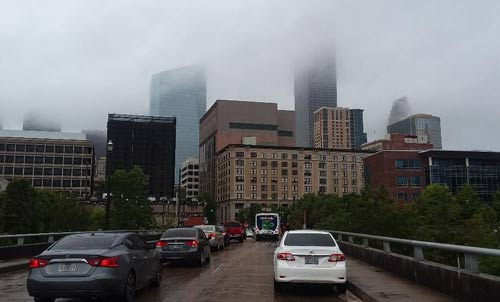
Houston is a city located along the Gulf of Mexico and has a humid subtropical climate.
Compared to Korea, summers are much longer, hotter, and more humid, while winters are mild. With the extreme weather typical of southern Texas and the risk of hurricanes, many Korean immigrants often need time to adjust to the climate. Let's take a closer look at Houston's weather by season.
Houston's summers are very hot and humid. From June to September, daytime temperatures rise to around 93-98°F (34-37°C), and due to the high humidity, it feels much hotter. The wet bulb temperature is high, posing a real risk of heatstroke during outdoor activities, and living without air conditioning is virtually impossible.
The average high temperature in June is around 93°F (34°C). This heat lasts until late September or early October, which often surprises newcomers who are not used to such a long heatwave compared to summers in Korea.
Houston's annual rainfall is about 50 inches (1,270mm), which is significantly higher than the U.S. average. It is similar to Korea's average annual precipitation (around 1,300mm), but the rainfall patterns differ. Rain tends to be concentrated in spring (April-May) and fall (September-October), with heavy downpours occurring frequently over short periods.
The entire city has a flat terrain, and the drainage system is vulnerable to heavy rains, leading to frequent road flooding after downpours. Hurricane Harvey in 2017 brought over 60 inches (1,524mm) of rain in just three days, resulting in the worst flooding disaster in Houston's history.
Hurricanes are the most serious climate threat to Houston, located along the Texas Gulf Coast. The hurricane season runs from June 1 to November 30, during which tropical depressions formed in the Gulf of Mexico can approach the Texas coast.
Hurricanes making landfall in Galveston significantly impact Houston as they move inland. Category 4-5 hurricanes, like Harvey (2017), can lead to large-scale evacuation orders. If you live in Houston, it is important to familiarize yourself with evacuation routes and prepare emergency supplies (water, food, medicine, etc.).
Winter weather is generally mild. The average low temperature in January is around 43°F (6°C), and it rarely drops below freezing. However, sudden temperature drops can occur when cold air moves down from the north, and when freezing rain falls, roads can become icy, causing significant disruptions.
The winter cold snap in February 2021 paralyzed the Texas power grid, forcing millions of households across Texas, including Houston, to endure the cold without heating or electricity. Snowfall is nearly nonexistent annually, and days with snow are so rare in Houston that they can be counted on one hand throughout a lifetime.
Nevertheless, spring and fall are pleasant seasons with comfortable temperatures, making them great for outdoor activities.
 skyvalleydreamer1990
 QuitRL







 virex |
 vexon87 |
 seouljung |
 Well Done Sir |
 Vision XT |
 Ham and Cheese |

 Texas Real Estate Blog |
 Nanana Nanana Nanana |
 SEVEN SEVEN |
  There Are Such Things in the World |
  Agenda Center |
  digital |
  timemachine |
  Starry Eyes |
  Desert King |
  U.S. Retirement Pension Information |
  Seattle - Emerald City |
  Texas Migration Story |
  Unknown Dog Walk blog |
  California Dreamer |
  Bearded Strawberry Smoothie |
  JESIKYEOALBA BLOG |
  Heart Ticker |
  Jellia Angel |
  Moo Tang Clan |
  Khan Film Blog Production |
  yenne |
  neroyo |