

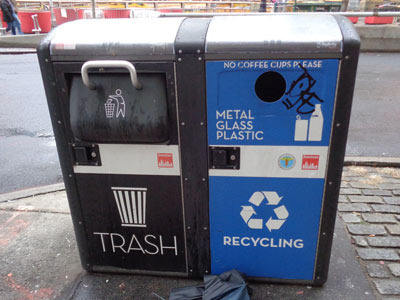
In the recycling industry, New York operates various programs for resource conservation and environmental protection, consistently working towards achieving a sustainable circular economy. Almost all resources, including plastics, paper, metals, glass, and food waste, are targeted for recycling, creating a structure where the state government, citizens, and businesses participate together.
Since the 1980s, New York has enacted laws for waste reduction and recycling. The early New York State Waste and Recycling Law mandated recycling by region and systematically defined the classification and collection system for recyclable resources.
Particularly, New York City is cited as a model for recycling policy, where both households and commercial facilities must separate paper, plastics, metals, and glass for disposal, with fines imposed for violations. Thanks to this thorough separation system, the city's recycling efficiency has significantly improved.
A key area that New York is strongly promoting is the reduction of plastic use. The plastic bag ban law, implemented in 2020, completely prohibits the use of single-use plastic bags in large supermarkets and convenience stores, encouraging the use of reusable bags instead. Additionally, regulations on single-use straws, cups, and packaging have been strengthened, and there is active investment in technology to improve plastic recycling processes. These policies have not only protected the environment but also changed citizens' lifestyles.
Another noteworthy aspect is the organic waste recycling program. New York actively operates a system for composting organic resources such as food waste and horticultural waste. In some areas, food waste from households is collected for biogas production or compost manufacturing, and businesses and restaurants are encouraged to participate in composting programs.
This approach reduces waste while producing energy or improving soil, resulting in significant environmental benefits. The recycling industry also makes a substantial economic contribution to New York. Numerous jobs are created in recycling plants, collection companies, and sorting centers, and products produced from recycled materials invigorate the local economy. By recycling waste into new resources, New York achieves both economic benefits and environmental protection.
However, there are challenges. In some areas, insufficient recycling facilities lead to lower processing efficiency, and a lack of citizen participation results in recycling rates falling short of expectations. For example, increased contamination or incorrect sorting can halt or necessitate the disposal of the recycling process itself. To address these issues, New York is strengthening educational campaigns and expanding programs that teach the importance of recycling at schools and community levels.
Looking ahead, New York aims to actively introduce advanced technologies for innovation in the recycling industry. Examples include automated sorting systems using artificial intelligence (AI), robotic sorting of recyclables, and efficiency improvements through data analysis. Once these technologies are fully established, it is expected that recycling speed and accuracy will significantly increase, reducing the burden on human resources.
Moreover, there is a vigorous movement to establish a 'Circular Economy.' The goal is to integrate all stages from production to consumption, disposal, and recycling into a single system, minimizing resource waste and maximizing reuse. In the future, New York will further strengthen legal regulations and create a sustainable environment through the expansion of recycling infrastructure and citizen participation.




 Moscow Kim |
 coloradoman |
 Montgomery Mom |
 GOGO SING |
 Hajiwon Blog Hair Salon |
 newyorker 101 |
 Things to Do to Buy a House |
 Lunch and Dinner Mexican Taco |
 International Court |
 French fries |
  Tora Tora |
  yellowbutter |
  Dolly |
  US Embassy |
  NYC saladbar |
  Finding Superfoods |
  lightyear |
  song bang |
  vexomo |
  Indiana Jones |
  meloncat |
  novapixel |
  mortrix |
  Esther 1983 |
  fortbliss |
  My Two Way |
  toastyfox |
  FLORIDA Acus |
  tracker |