

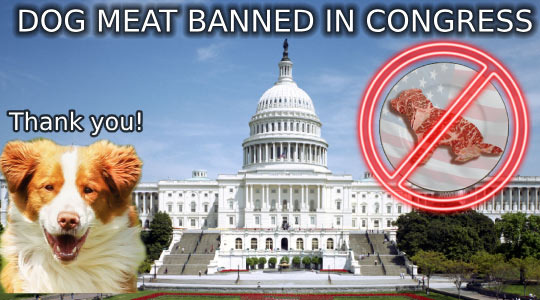
In the U.S., it is legally prohibited to sell dog and cat meat for consumption.
Surprisingly, this law, known as the Dog and Cat Meat Trade Prohibition Act, was passed in 2018, which may feel recent.
This is a federal law passed by the U.S. Congress. In fact, even before this law was created, there was almost no culture of eating dog meat in the U.S. This is largely because dogs are primarily viewed as pets in American society. Therefore, there was virtually no market for distributing dog meat for consumption.
However, it has only recently become completely illegal. Before 2018, some states had no clear prohibitions in place. That said, this does not mean there was a culture of eating dog meat; it simply means that there were instances where the law did not specifically address it.
So, what about the early history of the U.S.? Records show that there are a few instances where dog meat was consumed in extreme situations.
A notable example is during the American Westward Expansion. In the early 19th century, explorers and settlers moving west sometimes found themselves trapped in harsh conditions. When food ran completely out, there are records of them eating animals like dogs or horses to survive.
One of the most famous cases is the Donner Party incident in 1846. A group of settlers heading to California became trapped in a snowstorm in the Sierra Nevada mountains. As their food supply dwindled, some individuals resorted to eating dogs, according to records.
Another record mentions similar stories from 19th-century Arctic expeditions. When sled dogs ran out of food, there are accounts of explorers eating the dogs. In these cases, it was more a matter of survival than a cultural dietary habit.
During the American Civil War, there are also records of soldiers eating dogs or mules when food became extremely scarce. However, this too was more about extreme survival in wartime rather than a common food culture.
There are occasional questions about whether Native American societies consumed dog meat. To conclude, there are records of some tribes doing so in a limited manner. However, this was not a widespread food culture but rather a practice that occurred in specific regions and situations.
Before Europeans arrived in North America, various Native American tribes raised dogs for different purposes, such as hunting assistance, carrying loads, and guarding. Some tribes in the plains or northern regions have records of eating dog meat during special ceremonies or feasts. For example, some tribes in the Great Plains are said to have provided dog meat during traditional ceremonies or community events.
However, not all tribes did this. Some tribes viewed dogs as spiritual beings or companions and did not use them for food. Additionally, in many cases, dogs played important roles in hunting or transportation, making them not easy animals to eat.
In summary, while there are records of dog meat consumption in American history, it has rarely established itself as a food culture.
Thus, in modern American society, the culture of considering dog meat as food virtually does not exist. Most people view dogs as family-like pets, leading to strong feelings about this issue.
In this atmosphere, the federal law was ultimately created in 2018.
Now, dog meat consumption is prohibited by federal law in the U.S., and historically, it has rarely been established as a food culture. However, there are some records of dog meat being consumed in extreme survival situations, such as during the Westward Expansion or explorations.







 novapixel |
 Victory 1988 |
 washington mom |

 El Dorado |
 eatontown blog |
 Margarine Daebimama |
 santo melon |

 choi family |
  The Gelaton |
  Twist Kim |
  berlon93 |
  Physical Laws and Science |
  good thinking |
  Solo Yolo |
  Mr Oh |
  laro90 |
  San Diego TOP Idol |
  Round and Round Children's Song Kingdom |
  American Golf Course Travelogue |
  MEDBIO American Doctor Blog |
  Hot Seat Driver |
  bryvexi |
  koala organic farm |
  riverstone |
  My Antonio |
  California Information News |
  chilli chilli |
  Moon Su San |