

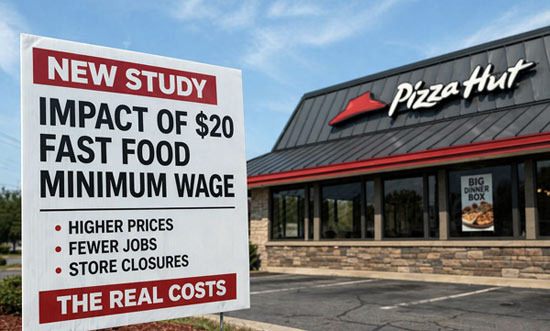
California's AB 1228 is a bill aimed at improving the treatment of fast food workers, with the key provision being a $20 increase in the minimum wage.Bill Number: AB 1228 (2023)
Author: Assemblymember Chris R. Holden (D-Pasadena) introduced by the Democratic Pasadena area representative
Signer: Governor Gavin Newsom signed on September 28, 2023
Passage Method: Processed as a partisan bill (Partisan Bill - Democrat 1)
- In just one year, California lost 22,717 fast food jobs, with 1,040 establishments considering closure
- California fast food prices increased by 14.5%, nearly double the national average of 8.2%
- 89% of restaurants in the state have reduced employee working hours, and 87% plan further cuts
- Pizza Hut had already laid off 1,200 delivery drivers before the law took effect
However, the problems arising from this are far from ordinary, yet we just carry on.
Looking at the numbers above, one might think, "A few stores closed," and move on.
But after hearing from a restaurant owner in Rowland Heights, I began to feel angry too.
Rowland Heights is home to many Korean restaurants that compete yet also support each other.
The law currently in question is AB 1228.
It was pushed by Chris R. Holden and signed by Gavin Newsom.
Originally, they proposed a minimum wage increase of $22, which was later reduced to $20.
The intention is to protect low-wage workers. Up to this point, it's hard for anyone to strongly oppose it.
However, one year after implementation, the result is that over 20,000 fast food jobs have been lost. 1,040 businesses are reportedly considering closure.
And the prices we pay for food have risen by 14.5%.
During the same period, fast food employment across the U.S. increased by 0.8%, while California saw a decline in jobs, which is a fact.
Now, stores are trying to survive by cutting working hours. 9 out of 10 have already reduced hours, and most plan to cut further.
And a symbolic scene: Pizza Hut had already laid off 1,200 delivery drivers before the law took effect.
Here's an important point: AB 1228 only applies to over 60 fast food chains.
However, as market wages rise, restaurant owners are deeply concerned about paying their staff.
If a fast food chain offers $20 an hour, they can't hire anyone at $16.
Ultimately, full-service restaurants will also be dragged into this situation. The law only targeted one side, but the shock spreads to the whole.
As a result, restaurants not covered by the law find themselves in a more ambiguous position.
It's hard to raise prices, labor costs are increasing, and customers are dwindling. This is a tough spot to endure.
Ironically, in November 2024, a proposal to raise the minimum wage to $18 statewide was voted down.
Isn't it funny? Some places are offering $20, yet they know that $18 is too much.
But the law that has already passed remains in effect. Even those who supported it are starting to acknowledge that "jobs have been lost."
So the changes happening now are more than just numbers. 24-hour establishments are decreasing. Late-night lit stores are disappearing.
From my perspective, the number of employees at burger joints is decreasing, automation is increasing, and menus are becoming simpler.
Consumers are paying higher prices, and menu choices are gradually diminishing.
In fact, over 1,000 restaurant owners sent an open letter to the governor. Yet, discussions about further increases are still happening.
The feeling that arises here is simple: "Why do we, living in California, have to bear all of this?"
When prices rise a little, we grumble but go back to eating out, and when our favorite places disappear, we feel sad and move on to others.
24-hour establishments are disappearing, leaving only automation and menu reductions.
Whether it started with good intentions or not, both workers and consumers are suffering, yet we continue to live through this process.


 novapixel |
 Victory 1988 |
 washington mom |

 El Dorado |
 Finding Superfoods |
 Famous Attractions in the United States |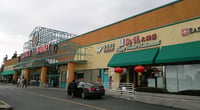
 American History This and That |
 Community Cross |
  My Circle |
  urban legend |
  coolriver |
  Good Neighborhood, Wealthy District Information |
  Ro Ro Car |
  Amber H |
  new sugar |
  Palm 1000 |
  loran |
  donutfield |
  Tennis City |
  sunny7 |
  Questions about firearms while living in America |
  Shoot Me |
  mochifox |
  zucchini |
  Anna Life |
  Exciting FM Radio |
  pet dog |