

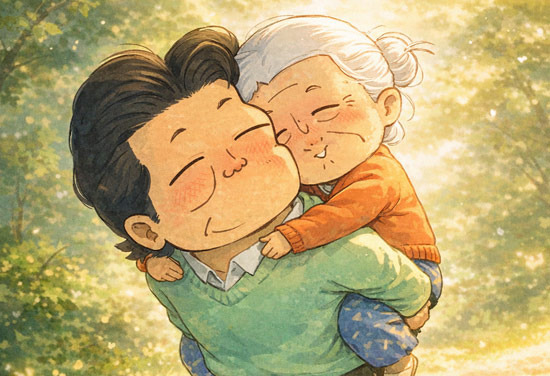
From a Korean perspective, if parents are struggling financially or with health issues, it is natural for children to help them.
However, when you hear about America, it's completely different.
This isn't just about a person's cold personality; it's about a different culture.
In America, raising children is fundamentally seen as a "responsibility".
Americans don't really view it as something they will "get back later".
In simple terms, raising children is not seen as an investment or sacrifice, but rather a basic duty.
So, when children become adults, the principle is that they live their own lives.
There isn't much of a concept that children should quit their jobs to take care of struggling parents.
This might feel a bit cold from a Korean perspective.
You might think, "Wait, do they really draw the line there?" But the point is that Americans see it the other way around.
If parents say to their children, "I raised you, so now you should repay me," it's viewed as turning the relationship into a transaction.
Especially, the phrase "You owe me" is something that evokes a strong rejection in American culture.
The moment family relationships are expressed in terms of debt, it becomes a contract rather than an emotional bond.
So, when they hear that, often the reaction is more of resistance than guilt.
That said, Americans don't completely ignore helping their parents. They do help. But the way they do it is different.
It's not because of "duty" but rather closer to the concept of "I want to help".
The important thing is that they only act within the limits of not disrupting their own lives. They don't make choices that would jeopardize their careers.
Ultimately, this difference comes from the fundamental assumptions about family.
In Korea, family is seen as a single community. They are intertwined, and responsibilities are connected.
But in America, the individual unit is fundamental. Even within a family, each person has their own space, and respecting those boundaries is important.
So, if you approach these situations only from a Korean perspective, conflicts are bound to arise.
One side thinks, "This is something you should naturally do," while the other thinks, "That's not my responsibility."
Neither is wrong; they just have different standards.
Realistically, it seems that these two cultures are mixing even in Korea these days.
The structure of unconditional sacrifice is decreasing, but it's not completely shifting to individualism either.
It feels like we are in a process of creating new standards somewhere in between.







 horse |
 Sunset Oregon |
 daisypat |
 Anjollinya Blog |
 Anova US Beauty Information |
 Margarine Daebimama |
 Google Idea |
 beerdreamer |
 Living in New Jersey blog |
 My Life is High Breeze and Gentle Wind |
  sparkling |
  maryland park |
  persiste |
  conte |
  blueman |
  Going Once |
  Eldorado 88 |
  cherrydino |
  garlic bread |
  middlekick |
  Moscow Kim |
  nivex85 |
  quanta7 |
  Tomato Health Club blog |
  Egg Steamed Pot |
  Helpful Life Stories |
  UNI Lover |
  zen zeng |
  oh my salami |