

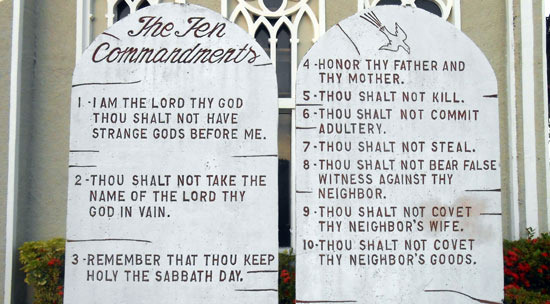
A federal appeals court has ruled that public schools in Texas can post the Ten Commandments in classrooms.
This ruling is seen as a significant event that reignites the long-standing debate over the boundary between religion and public education in American society.
The decision was made by the Fifth Circuit Court of Appeals, with a very narrow vote of 9 to 8. This indicates a divided opinion within the court itself. Ultimately, a majority of conservative judges formed the opinion that recognized Texas law.
The key issue is relatively clear: whether posting specific religious content within a public school, a state institution, violates the Constitution.
Opponents have strongly argued against it based on the principle of separation of church and state as stated in the First Amendment of the U.S. Constitution. In contrast, supporters emphasize that the Ten Commandments have served as a historical foundation for American law and morality beyond just being a religious phrase.
The majority opinion of the court accepted this supporting argument. The ruling clarified that it does not compel students to recite or enforce specific beliefs. In other words, simply having it posted does not constitute an act of imposing religion. This aspect can be considered the crux of the ruling.
However, dissenting judges pointed out that since the founding of the Constitution, the United States has emphasized the separation of church and state to prevent any specific religion from exerting influence through political power. They expressed concern that this law could undermine that principle by placing specific religious texts in public schools.
The ACLU, which led the lawsuit, has also strongly opposed the ruling. They emphasize that the choice of what religious education to provide to children should be a family decision, arguing that this ruling infringes on that right. They have also indicated plans to appeal to the U.S. Supreme Court.
Texas has shown movements to expand religious elements in education for several years. In 2024, a curriculum including optional Bible content was introduced in elementary schools, and discussions are ongoing about including Bible stories in required reading lists. The Ten Commandments posting law is also a policy that emerged from this trend.
This law was signed by Governor Greg Abbott and will take effect in September 2025. It is one of the most proactive attempts nationwide to allow the posting of the Ten Commandments in public schools. However, it is structured so that it can only be posted if there are donated posters, meaning it is not enforced in all schools.
This ruling is not limited to Texas. Similar bills are being pursued or implemented in states like Louisiana and Arkansas.
In fact, Louisiana had already allowed the enforcement of related laws prior to this ruling. This reflects a typical trend of policies starting in one state and spreading to others.
Politically, the Republican side views this ruling as a restoration of moral values, with Attorney General Ken Paxton emphasizing the importance of students having the opportunity to learn through the Ten Commandments. Conversely, the Democratic side expresses concern that the neutrality of public education may be compromised.
This issue is not simply about what to hang in classrooms.
It raises fundamental questions about how far American society will allow religion in the public sphere and how to delineate individual freedoms from the role of the state.
Given the current trend, it seems likely that this debate will not end easily.
If it reaches the Supreme Court, it could lead to a significant precedent affecting education policy across the United States.
 GomexK







 novapixel |
 Victory 1988 |
 washington mom |

 El Dorado |
 Gorama Round |
 ultron78 |
 There Are Such Things in the World |
 U.S. Weather Bureau News |
 Texas Lone Star Longhorn Spirit |
  My Circle |
  urban legend |
  coolriver |
  Good Neighborhood, Wealthy District Information |
  Ro Ro Car |
  Amber H |
  new sugar |
  Palm 1000 |
  loran |
  donutfield |
  Tennis City |
  sunny7 |
  Questions about firearms while living in America |
  Shoot Me |
  mochifox |
  zucchini |
  Anna Life |
  Exciting FM Radio |
  pet dog |