

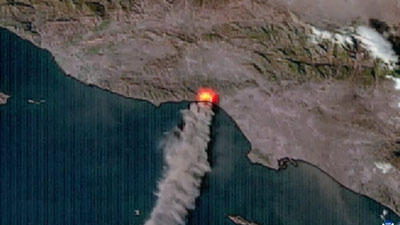
On the 7th, strong gusts swept through the Los Angeles (LA) area, the largest city in the western United States, keeping residents awake all night. On that day, wind speeds in the LA area were estimated to reach up to 100 miles per hour (about 160 kilometers). Weather authorities warned that such hurricane-level winds could cause power lines to break or large trucks, trailers, and RVs to overturn while traveling on the freeway.
As the strong winds continued, a wildfire broke out in the Pacific Palisades area, located on the coastal hills. According to California fire authorities, the fire, which started around 10:30 AM, rapidly spread due to the fierce winds, reaching an affected area of 772 acres (3.12㎢) in about three hours. By 4:14 PM, about six hours later, the fire had expanded to 1,262 acres (5.1㎢), larger than the area of Yeouido (4.5㎢).
The LA Fire Department reported that approximately 10,000 households, totaling about 30,000 residents, were put at risk and received evacuation orders. Nearby roads saw drivers abandoning their vehicles, and news reports showed fire authorities pushing abandoned cars with bulldozers as fire trucks were blocked from entering.
According to U.S. media, including the AP, President Joe Biden was scheduled to attend an event announcing the establishment of a new national monument in Riverside County, east of LA, but the schedule was postponed due to the strong winds in the area.
According to CNN, 'Southern California Edison,' the company supplying electricity to the LA area, began proactively cutting power to about 8,600 households (including commercial facilities) due to fire risks. The company also stated that it is considering cutting power to an additional approximately 400,000 households.
The LA Unified School District announced that only some schools would be closed for the day on the 8th. The schools affected include Topanga Elementary Charter, Woodland Hills Academy, Palisades Elementary, Brent Magnet, Marquez Charter Elementary, Diego Rivera Learning Complex, and University High School, which will all have temporary closures today.
The strong winds known as 'Santa Ana' are localized gusts that blow from the Sierra Nevada mountains to the California coast, occurring frequently in the fall and winter. Experts analyze that there has been no rain of more than 2.5㎜ in the Southern California region, including LA, since early May, and the ongoing dry conditions are further increasing the risk of wildfires.
About Santa Ana Winds
Santa Ana winds are a powerful dry wind phenomenon that primarily occurs in California, blowing from the Sierra Nevada mountains to the California coast. These winds typically occur in the fall and winter, especially blowing more frequently and strongly during the winter. The speed of Santa Ana winds often reaches 50 miles per hour (about 80 kilometers) and can sometimes exceed 100 miles per hour (about 160 kilometers).
Santa Ana winds have the following characteristics:
Dry air: Santa Ana winds bring very dry air, which can cause temperatures to rise sharply. These dry conditions significantly increase the risk of wildfires.
Strong wind speeds: Strong winds can damage trees and buildings, increase the risk of power lines breaking, or large vehicles overturning. Additionally, the strength of the winds can lead to evacuation orders being issued.
Wind direction: Santa Ana winds are localized winds blowing from the Sierra Nevada mountains to the California coast, blowing only from specific directions. This directional nature makes it difficult to predict and leads to unstable weather conditions.
Increased wildfire risk: Santa Ana winds are one of the main causes of rapidly spreading wildfires in already dry forest areas. When the winds blow, even small fires can quickly escalate into large wildfires.
Santa Ana winds have a significant impact on residents living in California, especially during wildfire season, requiring thorough preparation. Due to their strength and unpredictability, Santa Ana winds are one of the most notable natural phenomena in California's weather.



 US Embassy |
 fortbliss |
 Folding Instructions |
 yentra |
 Cali M Law Group |
 Fun Flex Life |
 Experiences Living in America |
 MacMorningBlog |
 Korean Mom |
  My NYC |
  moo moo |
  Mr Oh |
  forevergee |
  festival |
  manchester |
  constant |
  Leapfrog Move |
  vibranto |
  Tora Tora |
  yellowbutter |
  Dolly |
  NYC saladbar |
  Finding Superfoods |
  lightyear |
  song bang |
  vexomo |
  Indiana Jones |