

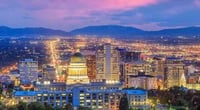
I have lived in Salt Lake City for over a decade now.
When I first moved here, I honestly didn't understand why the locals were so proud of the Great Salt Lake.
You can't even swim in the salty lake properly, and in the summer, the unique smell can waft into the city depending on the wind direction.
However, after a few years, I came to deeply feel that this lake is like the lungs of the entire region.
These days, when I meet neighbors at the local café, there's a topic that always comes up: President Trump's announcement that he would spend $1 billion to save our lake.
On February 21, he posted on Truth Social, "Protecting the Great Salt Lake is extremely important. It's an environmental disaster that needs immediate attention," and a few days later, he even twisted his own slogan to say, "Make The Lake Great Again."
Utah is a Republican stronghold, and I am a conservative voter, but honestly, I didn't expect him to be so sincere about environmental issues.
How Did the Great Salt Lake End Up Like This?
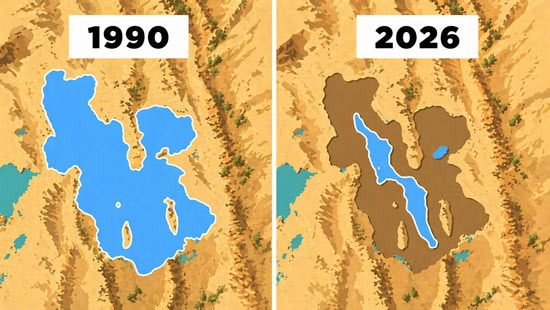
When I first came here, the Great Salt Lake was a massive lake, larger than the state of Delaware, covering 2,300 square miles.
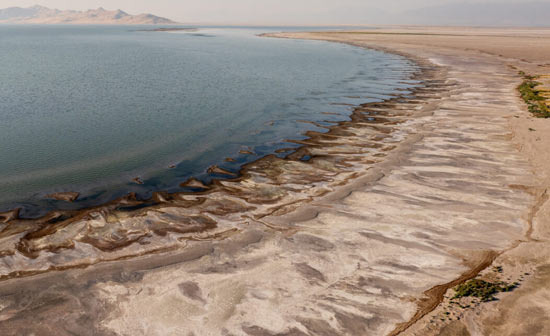
Now, over 1,000 square miles of dry lakebed is exposed where the water has receded.
The problem is that this lakebed is filled with arsenic, heavy metals, and toxic substances.
On windy days, this dust rises into the air, affecting not just Salt Lake City but also Wyoming and Idaho. About 2.5 million people are directly threatened with respiratory health issues.
My youngest child has asthma, so I check the air quality app every day, and when the numbers suddenly worsen during the windy spring, I honestly feel a pang of fear. It's no wonder that BYU ecology professor Ben Abbott referred to this lake as an "environmental time bomb."
Moreover, this lake is not just a simple puddle. Up to 50 percent of the world's brine shrimp come from here. Brine shrimp are not for human consumption; they are the feed for young fish and farmed shrimp. Additionally, key minerals like lithium and magnesium are also mined from this lake.
It is also a resting place for millions of migratory birds, and most importantly, the reason Utah boasts "the best snow on Earth" is due to the moisture from this lake.
Considering how much the local economy thrives during ski season, the drying up of the lake means the entire local economy is at risk.
Are All American Lakes Drying Up?
This is not just a problem for the Great Salt Lake. Except for the Great Lakes, all the major lakes in the western United States are currently suffering.
Lake Mead, on the Nevada-Arizona border, is experiencing record low water levels, and Lake Powell just above it is in the same situation.
California's Salton Sea has been shrinking for decades, causing a spike in asthma and lung disease among local residents due to toxic dust issues.
I often see articles about the fluctuating water levels in Oregon's Klamath Lake, California's Mono Lake, and even lakes in northern Montana.
The reasons are quite similar. There is too much water being drawn for irrigation agriculture, winter snowfall is decreasing, and the population continues to grow.
Utah is no exception, as the winter of 2026 recorded the worst snowfall ever.
One day in February when I went skiing, I was shocked to see that half of the slopes were bare ground; I thought to myself that this could lead to a serious problem.
When I heard this, I was curious. Why did a president from New York suddenly take an interest in Utah's salty lake?
It turns out he had connections. Mark Burnett, who produced The Apprentice, moved to Utah and became a board member of a lake conservation organization, and he has been consistently sharing information with the White House.
Additionally, Governor Spencer Cox had the opportunity to meet with the president while attending the National Governors Association in Washington, and their scheduled 15-minute meeting extended to an hour and a half.
When Governor Cox requested $1 billion, it honestly made me laugh that Trump didn't even blink.
This is a man who cuts environmental budgets left and right, yet he is willing to spend money on this issue. It's a testament to how realistic and urgent this problem is, regardless of ideology.
Hopeful Yet Concerned
It is said that for the lake to recover, at least 500,000 to 800,000 acre-feet of water must flow in each year.
There are analyses suggesting that to restore it to its previous levels before the 2034 Winter Olympics, 1 million acre-feet annually will be needed.
That's an enormous amount of water. Simply pouring money into the issue won't solve it; it's a complex battle that involves water rights, agricultural practices, and inter-state water distribution.
Moreover, Congress must give final approval, and the 2027 fiscal year budget is already facing cuts from various sources, making passage seem difficult.
However, as a local resident and a father raising children in this land, I hope that regardless of political leanings, this time they will push for it properly.
If we can succeed in restoring a salty lake on the brink of collapse, something no country has ever achieved, it will be a significant milestone not just for Utah but for the entire lake issues in the western United States.
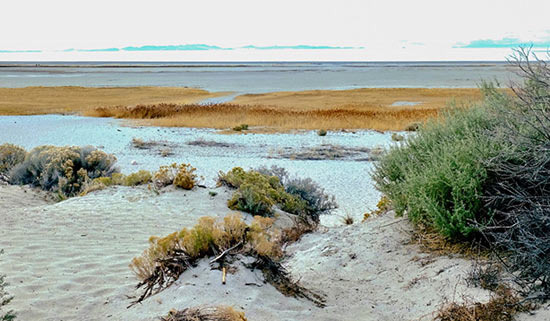
This morning on my way to work, I looked down at the lake from the hill, and the salt crystals reflecting in the sunlight were spread out much wider than before.
Thinking about how that should have been water made my heart heavy. I truly hope this time things will change.




 Twist Kim |
 U.S. Weather Bureau News |
 Community Cross |
 Conflite Teacher |
 SEVEN SEVEN |
 Utah, the Most Livable State |
 Tan Sol |
 loran |
 morvex37 |
  AliAluAlo Blog |
  Giant Squid and Sweet Potato Soup |
  Valley Hong |
  The Gelaton |
  berlon93 |
  Physical Laws and Science |
  good thinking |
  Solo Yolo |
  Mr Oh |
  laro90 |
  San Diego TOP Idol |
  Round and Round Children's Song Kingdom |
  American Golf Course Travelogue |
  MEDBIO American Doctor Blog |
  Hot Seat Driver |
  bryvexi |
  koala organic farm |
  riverstone |
  My Antonio |
  California Information News |