

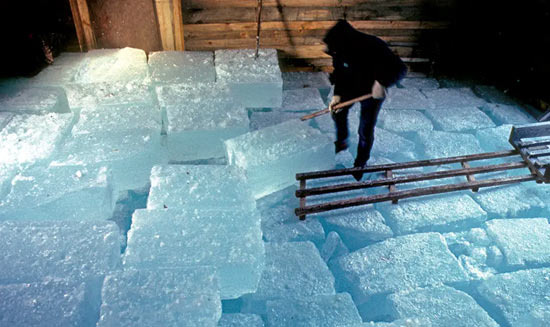
Can you believe that 90,000 people were involved in the ice trade in 19th century America?
Today, ice is so common. You can find it in your refrigerator, at convenience stores, and cafes serve drinks filled with ice as a matter of course.
However, in 19th century America, ice was a technology that made food preservation possible and was also a commodity driving international trade. It may seem hard to believe by today's standards, but at one time, thousands of people in America were engaged in cutting, transporting, storing, and delivering ice.
At its peak, records show that about 90,000 workers and 25,000 horses were connected to this industry.
At the heart of this massive industry was a man named Frederick Tudor. Born into a wealthy family in Boston, he is said to have been inspired by the winter ice of Boston while traveling in the Caribbean during his childhood.It may sound a bit absurd today, but at the age of 23 in 1806, he actually experimented by loading ice harvested in Massachusetts onto ships bound for Martinique. At the time, Boston newspapers almost mocked this voyage, as the idea of selling ice in tropical regions seemed too unrealistic.
The first voyage ended in loss. During the nearly three-week journey, much of the ice melted, and sales did not meet expectations. However, the important thing was that the ice did not completely disappear. In other words, he confirmed that if he could find a method, this business could be viable.
What was truly remarkable about Tudor was that he did not stop there. He relentlessly explored why ice melted and how it could be preserved. The solution he found was insulation materials like sawdust, wood shavings, and rice husks. While it may seem simple today when thinking about the principle of iceboxes, it was an innovation at the time.
By wrapping the ice blocks with these materials, external heat could not be transferred immediately, significantly slowing the melting rate. Moreover, sawdust was a cheap byproduct easily obtainable from sawmills. Thus, it was both technically sound and economically viable. Based on this simple idea, Tudor built ice houses and developed similar methods for loading ice onto ships to reduce loss rates.
From this point on, ice export became a repeatable business model rather than a reckless gamble. The following year, in 1807, he began sending ice to Havana, Cuba. In tropical regions, ice was not just a luxury but a completely new sensation. The concepts of cold drinks, chilled desserts, and freshness created a lifestyle that was different from before.
In particular, hotels and high-society social culture were the first to feel the benefits of ice. In Havana, a beverage culture utilizing commercial ice quickly took root, and this experience became an important foundation for the later development of Caribbean cocktail culture.
Tudor eventually built an ice storage facility in Havana. This ice warehouse, established in 1815, was not just a storage facility but an infrastructure that changed the business landscape. With stable storage, losses were greatly reduced, and supply became much more consistent.
By the 1830s, ice became a global commodity reaching beyond the Caribbean to India, China, and South America.
In particular, the voyage that left for Calcutta, India in 1833 was a symbolic event. After nearly four months of a long journey, a significant amount of ice actually arrived, and this route established itself as a highly profitable line for a long time.
From today's perspective, this was not just a bizarre adventure but the prototype of refrigerated logistics. The concept of 'transporting over long distances while maintaining cold' was already being experimented with and commercialized in the early 19th century. For people in hot regions at the time, American ice was a fascinating import and a product that changed their standard of living.

The production system within the United States was also impressive.
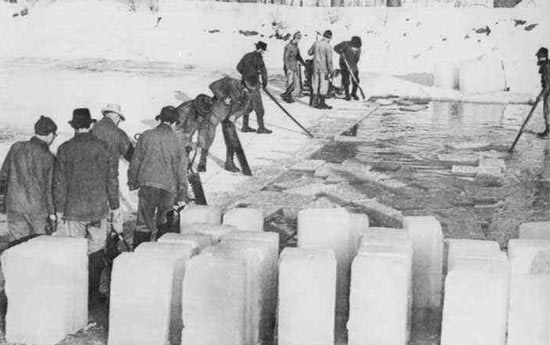
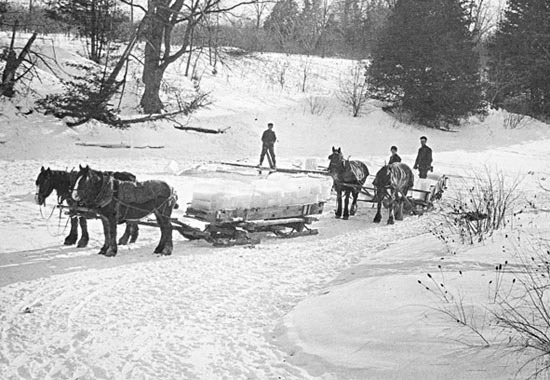
In winter, the Hudson River and lakes in New England transformed into massive mining sites. When the ice froze to over 12 inches thick, workers would draw lines on the surface and use special saws and cutting equipment to cut the ice into grid-like blocks. The cut ice was transported to storage facilities via horse-drawn devices and conveyor-like systems.
Ice was not simply taken from nature; it was produced through nearly factory-standard operations.
Along the Hudson River, about 135 large ice houses lined the banks, and some people recalled that if you followed the upper Hudson, you would almost always see ice warehouses in sight. These warehouses were advanced storage facilities by the standards of the time, featuring double-wall structures, thick insulation layers, and drainage designs.
Thus, by the late 19th century, the ice industry in America grew to an unimaginable scale.
Boston ice was sold to various parts of the world in excess of 100,000 tons annually around 1850, and the entire American ice industry grew to about $28 million by the end of the 19th century. Even when simply converted to today's value, it was a significant industry that played a role in enabling long-distance distribution of meat, fish, and dairy products, transforming the entire food industry.
A significant number of households in New York utilized ice delivery services, and in urban life, the 'iceman' became as familiar a figure as the milkman. Ice became synonymous with modern urban life itself. It allowed people to drink milk in summer, keep meat fresh for a bit longer, assist in medical treatments, and, above all, spread cold beverages to the public.
However, this industry also began to lose its price competitiveness against natural ice as mechanical ice-making and refrigeration technology advanced from the late 19th century. Initially, natural ice was still cheaper, but as technology improved, artificial ice became more advantageous in terms of stability and hygiene. As urbanization progressed, concerns about the water quality of rivers and lakes also grew.
The final blow came with the spread of home refrigerators in the early 20th century.
As the era arrived when people could maintain coldness directly in their homes, the old system of cutting and storing ice every winter rapidly became outdated. Additionally, with World War I reducing international trade volumes, long-distance ice trade also lost its strength.
Ultimately, the natural ice industry slowly but surely faded into history.
The claim that 90,000 people once made a living from ice in America is not an exaggeration.
In that era, there were no refrigerators, and the ability to keep things cold was an infrastructure that moved society. Today, we take for granted that ice drops with the push of a button and that we can enjoy cold drinks, but behind that normalcy are the workers who stood on winter rivers cutting ice and the determination of a businessman who dared to sell that ice halfway around the world.
Even in the moment we thoughtlessly fill a cup with ice today, we are naturally enjoying the traces of that old industrial revolution.







 Conflite Teacher |
 SEVEN SEVEN |
 Korean Mom |
 novapixel |
 Peter Pan Pet |
 tiramisu |
 NO CAP LIFE |
 bagel90 |
 lattecu |
 U.S. Weather Bureau News |
  vexo90 |
  As Always Today |
  veltar87 |
  United States National Administrative Organization Stories |
  springwaltz |
  dense |
  Tiger Milk Foam Research Institute |
  Oreore Mushroom |
  optimistic |
  Good Good |
  berion88 |
  bravo777 |
  skyblue |
  Project Tomorrow |
  apricotla |
  Soy Angelino |
  nati8 |
  NE Hodori Preik |
  washington mom |
  celtics |