

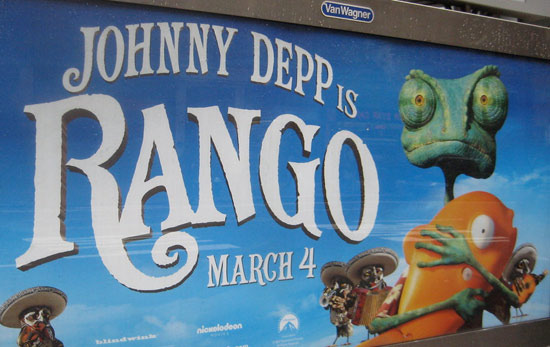
Recently, I watched the animation Rango, starring Johnny Depp, which is over 10 years old.
Honestly, I found it much more entertaining and better made than most animations coming out these days.
When it first premiered, I viewed it merely as a parody of Westerns, but with time, I realized this film is closer to a genuine movie that borrowed the format of animation.
Rango is special because its characters are different. The protagonist is neither a hero nor someone with abilities from the start. It's the story of a chameleon who, having lived in a glass box, accidentally falls into the desert and survives by deceiving himself.
Johnny Depp's voice is not exaggerated but rather anxious, full of bravado, and somewhat twisted. It contrasts with the clear lines of good and evil and the growth formulas typically shown by animation protagonists. This discomfort makes Rango more memorable.
The biggest reason this film remains a masterpiece is its world-building. It adopts the grammar of Westerns while centering on the realistic issue of water scarcity. The desert town of Dirt is not just a simple backdrop; it resembles a microcosm of modern society.
Those who hold water have power, and they manipulate the system to maintain that power. Even though it's an animation, themes of politics, power, and identity are naturally intertwined. This is why adults nod along more than children do.
The direction is still astonishing to this day. Gore Verbinski's unique camera work and lighting, reminiscent of live-action films, often make you forget that it's an animation.
Gore Verbinski is known for his direction that doesn't confine itself to genres. He has created entirely different works, from pirate films to Westerns and animations, all while excelling in world-building and visual quality. In Rango, he transferred the live-action film's camera sensibility and dark humor directly into animation. He is regarded as a director who pursues both commercial and experimental aspects.
Thus, the character design feels quite awkward, lacking any sense of familiarity. Rather, it leans towards the bizarre. The faces are wrinkled, rough, and covered in desert dust. This aspect seems to be both a strength and a limitation of Rango.
If you ask why a sequel hasn't been made, the answer might be quite clear. Rango was not a commercially successful franchise. It made a profit, but it didn't have the structure to be milked into a series like Toy Story or Shrek. It's also not easy to merchandise the characters, and it's not a film aimed solely at children. It strays far from the safe formulas Hollywood favors these days.
Another reason is the changing status of Johnny Depp as an actor. At the time Rango was released, Johnny Depp was an irreplaceable character actor in Hollywood. Now, the situation has changed significantly. After controversies and lawsuits, he has become an actor that major studios find difficult to associate with. Rango relies heavily on Johnny Depp's voice and image, making it challenging to continue the series with another voice actor.
Above all, Rango is a film that doesn't necessarily need a sequel. The story concludes neatly. The protagonist sheds his bravado, and the town regains true order. There's no need to forcefully expand the world or escalate the conflict. In an era where every work must be tied into a universe and expand its world to survive, Rango stands out as a highly complete standalone film.
This makes it even more regrettable. Looking at today's animation market, while technology has advanced, the content has become increasingly safe. The stories are ones that everyone can understand and that don't make anyone uncomfortable. It's becoming harder to find animations that are as strange, dark, and mature as Rango.
Even though it's over 10 years old, it doesn't feel outdated; rather, it's bolder than many recent films. Perhaps that's why Rango remains a masterpiece without a sequel. It's a film that is both regrettable for not having a sequel and one that doesn't necessarily need one.
I feel that Rango still stands in that peculiar position today.







 Tan Sol |
 Day by day |
 Kitchen Ideas |
 Iowa Egen Aunt |
 Beauty, Health, Lifestyle Blog |
 Conflite Teacher |

 Choco Choco Star |
 There Are Such Things in the World |
 Exploring American Life Information |
  road98 |
  Churros Train Conductor |
  gleeful |
  Burbank Lee |
  Olivia's Blog |
  Bushing Around Life |
  Active |
  Cherokee Rose |
  Kor. Master |
  Holey Moley |
  Hodong Prince Over Flex |
  Mist inn |
  citrus pop |
  Onion Ring |
  phoenixia |
  viewtop |
  loverun |
  Kim Do Sun |
  SEVEN SEVEN |