

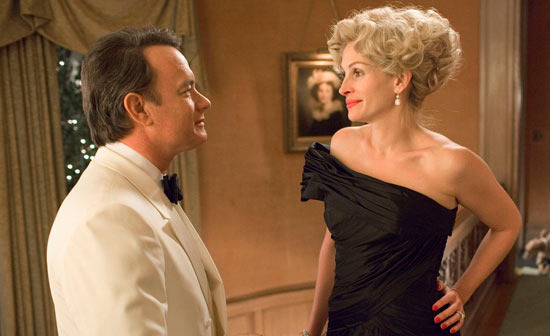
Among the films set in Washington D.C. and Northern Virginia, there are works that directly feature the CIA Langley headquarters.
One of them, Charlie Wilson's War (2007), is a political drama based on true events that simultaneously shows the inner workings of the CIA and the world of congressional lobbyists. Directed by Mike Nichols, it stars Tom Hanks, Julia Roberts, and Philip Seymour Hoffman. Interestingly, this film is also the last work of the renowned director Mike Nichols.
The film depicts the process of Congressman Charlie Wilson (played by Tom Hanks), a representative from Texas in the 1980s, teaming up with CIA agent Gust Avrakotos (played by Philip Seymour Hoffman) to push for large-scale military support for the Afghan Mujahideen. This operation, which secretly provided Stinger missiles through the CIA in response to the Soviet invasion of Afghanistan, is an important page in Cold War history.
The screenplay is written by the master of political drama, Aaron Sorkin, whose signature rapid dialogue and witty developments flow throughout the film. The internal scenes of the CIA Langley headquarters appear multiple times, showcasing how the McLean-Langley area functions as the heart of U.S. national security policy. The geographical connection between Northern Virginia and Langley is vividly portrayed on screen.
In the film, the CIA agent Avrakotos, played by Philip Seymour Hoffman, is depicted as a difficult and straightforward character with exceptional skills. His performance, which shifts from overturning desks and cursing at superiors to becoming a cold strategist in the next moment, elevates the energy of the entire film and earned him an Academy Award nomination for Best Supporting Actor, as well as a nomination for the Golden Globe.
The party culture of Washington, the world of congressional aides, and the internal conflicts of the CIA bureaucracy are depicted with humor, making it easy to watch. Unlike most political dramas that tend to have a heavy tone, this film is characterized by its elements of black comedy.
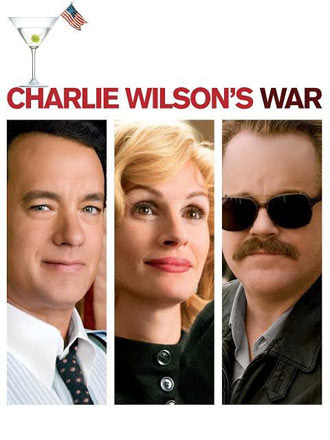
Looking at the box office performance, the film was released in the U.S. on December 21, 2007, with a production budget of $75 million. In its opening weekend, it earned about $9.65 million from 2,575 theaters in North America, starting at number four at the box office. Ultimately, it grossed approximately $66.66 million in North America and about $52.82 million overseas, totaling a worldwide gross of $119.48 million.
While it recouped its production costs, it is considered to have fallen short of the break-even point when marketing expenses are taken into account. There were reactions that the performance was somewhat disappointing given the star power of Tom Hanks and Julia Roberts, but the critical reception was very positive, with a Rotten Tomatoes score of 82% (based on 205 critics) and five nominations at the Golden Globes, including Best Motion Picture (Musical or Comedy).
In the overseas market, the largest markets were the UK and Ireland (about $8.9 million) and France (about $4.8 million). Since the film deals with the U.S. Congress, the CIA, and U.S. foreign policy in the 1980s, it seems there was a barrier to entry for non-English speaking audiences.
Nevertheless, this film has been reevaluated over time. In the historical context leading to the U.S. involvement in Afghanistan after 9/11 and the withdrawal of U.S. troops from Afghanistan in 2021, as well as the Taliban's return to power, the final scene where Congressman Wilson is frustrated by not securing additional funding for school and road construction resonates even more heavily.
Charlie Wilson's War is a film that artistically proves that Northern Virginia is not just a residential area but a key stage in U.S. national security. The characteristics of this region, where the CIA, the Department of Defense, and the National Security Council (NSC) operate, provide optimal conditions for the backdrop of espionage and political genre films like this one.
Living in Fairfax and McLean, one might feel a strong familiarity with the spaces depicted in this film. When considering that the ordinary roads and buildings passed during commutes are actually spaces frequented daily by figures who influence global affairs, this film becomes a mirror reflecting the hidden face of the neighborhood we stand on, transcending the boundaries of a simple political drama.
 joyfulmomentmaker1979
 Fruity Pebble
 KiwiGymFairy






 Kitchen Ideas |
 Iowa Egen Aunt |
 Beauty, Health, Lifestyle Blog |
 Always Atlanta |
 RV Samuel's Dad |
 Alpha and Omega World |
 Yellow Snowman |


 horse |
  moodansa 77 |
  zymit |
  maplefox |
  Fun Flex Life |
  hopeful |
  Reeno |
  Coastal city |
  meonetoo |
  Winter bear |
  Peach Jam Eating Laughter |
  Nando Raldo |
  American Man in a Mask |
  wendra |
  silver |
  bada2002 |
  horizon |
  Nanana Nanana Nanana |
  victoria jung |
  Kkikki Ppappa Shout Out Loud |