

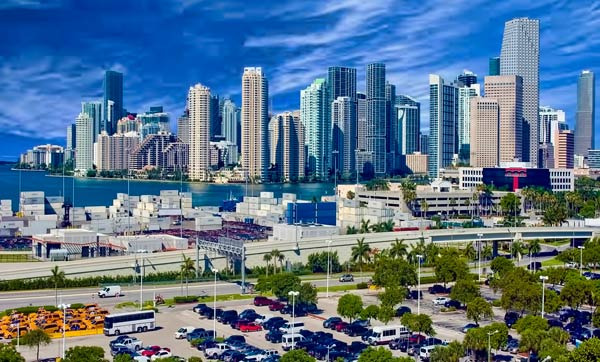
To understand why the Miami real estate market is consistently hot, one must first grasp the city's atmosphere.
Miami is not just a beautiful beach resort city. It uniquely blends Latin culture, international capital, tax benefits, influx of financial and tech capital, and a fervor for real estate investment. These elements ignited simultaneously, leading to explosive market growth. In simple terms, the southern beach city has become a magnet for capital from New York and Latin America.
First, the tax structure is attractive to investors. Florida has no state income tax. For those making money, this is a significant advantage that allows for quick mental calculations. This is why high-income individuals, corporations, and investors choose Miami as a second home or a destination for tax avoidance (legal tax reduction).
Each year, the number of wealthy individuals moving down from New York and California, tired of taxes, has increased, and as they began purchasing homes, prices naturally rose. Especially after the pandemic, with remote work becoming possible, a trend emerged questioning, "Is it necessary to pay high rent in New York?" Working near warm waters while reducing taxes and increasing housing assets has become a win-win situation.
Another crucial factor is foreign capital, particularly money coming from South America. As political and economic instability grows in countries like Venezuela, Brazil, and Argentina, the wealthy seek safe places to move their money. Miami has become that destination.
Walking down the street, Spanish is heard as much as English, and Latin culture is deeply embedded in the city's identity. Real estate plays a role in pushing prices up beyond local demand as this capital flows in. The concept of "not buying a home to live in, but to park money" has driven the investment market.
Of course, the pace of real estate development is also tremendous. Skyscraper condos continue to rise in downtown and Brickell, and luxury brand residences—like Lamborghini and Porsche Towers—are emerging, creating buzz. Buying a home means condos where you can load your car into the elevator, penthouses with both pool and beach views, all of which stimulate the interest of foreign investors. At this point, real estate operates not just as living space but as a means to showcase status and assets.
Population influx has also heated the market further. Young entrepreneurs, engineers, and finance professionals from across the U.S. are flocking in, creating a new economic ecosystem. There's a reason Miami is referred to as the "Silicon Beach of the East." With an increase in tech conferences, startup networking, and co-working spaces, IT, blockchain, and fintech have become vibrant. When money flows in, people gather, and when people and businesses come together, home prices naturally rise.
However, not everything is rosy. The risks of hurricanes, rising insurance costs, and sea level rise are realities that investors cannot ignore. Particularly, insurance premiums have risen significantly in recent years, and some insurers have even left Florida. Nevertheless, the market still feels overheated. The reason is that demand is too high, and supply struggles to keep pace.
In summary, the strength of Miami's real estate is not solely due to its natural environment. It is the result of a combination of tax benefits + influx of foreign capital + remote work trends + commodification of investments + urban appeal.
Miami currently stands perfectly aligned with the direction of money flowing in the U.S. There are many variables such as exchange rates, politics, and climate risks, but at least based on the current trend, the reason for "why the real estate market is going crazy" is understandable.
In short, Miami is a city built on finance and leisure capital above the sea. It can be seen as a place where money flows in continuously.





 moo moo |
 ultron78 |
 garlic bread |
 Sugar Cream Door Bulletproof Noodles |
 urbanmint |
 oh my salami |
 Komet Park |
 Victory 1988 |
 US Home Buying Information Home Insurance |
 Dr. Kelso |
  Tonky |
  viroma |
  cookie |
  Live and that's it |
  Alright Twain |
  eatontown blog |
  HAWAII Korean Church News |
  Amore |
  linex |
  Balancework |
  laro90 |
  MEDBIO American Doctor Blog |
  SWAT TEAM BLK |
  DREAM BIG |
  frostbite |
  330 Forever My Love |
  El Dorado |
  dralix58 |
  Gorama Round |
  Skydiving |