
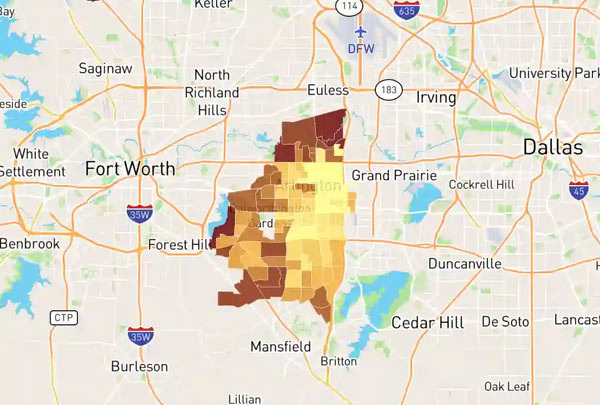
There's one important thing I want to tell those considering a move to Arlington.
Before deciding based solely on home prices, school districts, and jobs, you must be aware of the weather and natural disaster risks. This is because Arlington is located in an area often referred to as "Tornado Alley" by meteorologists in the United States.
When people first move to Texas, many think of tornadoes as something out of a movie. I did too. But after experiencing one spring, my perspective changed. When the tornado warning goes off on your phone and the TV shows real-time radar with the meteorologist mentioning neighborhood names, you start to realize this is reality.
In fact, Arlington and the DFW area are classified as regions where strong thunderstorms and tornadoes frequently occur in the U.S. April and May are particularly critical months. This is due to the collision of warm, humid air from the Gulf of Mexico and cold air from the north, which can create powerful supercell storms. Over the past few decades, hundreds of tornadoes have been recorded within a few dozen miles of Arlington, some causing significant damage to homes and commercial properties.
However, the natural disaster that residents often feel more frequently is hail. While hearing about golf ball-sized hail might seem exaggerated in Korea, it's a common occurrence in North Texas every year. One day, the sky suddenly turns dark, and hail the size of baseballs can fall, shattering car windows and damaging roofs within minutes. This is why car insurance rates in this area are often higher than in other regions.
The Winter Storm Uri that occurred in February 2021 is still a topic of discussion among many residents. The power grid across Texas failed, leaving millions without electricity. Arlington was no exception. Heating systems stopped, and pipes froze and burst, causing repair appointments to be booked weeks in advance. Grocery stores ran out of bottled water and bread, and stores were crowded with people trying to find generators.
Many residents realized something during that time: the stereotype that "Texas doesn't get snow" might be wrong. While it's usually warm, an unusual cold snap that comes once every few years can cause far more damage than expected.
The risk of flooding cannot be ignored either. Although Arlington has a relatively flat terrain, heavy rainfall can quickly turn roads into rivers. It's especially important to check the flood risk in low-lying areas and near rivers. This is also why people check FEMA flood maps when looking for homes.
So how should you actually prepare?
Residents of Arlington typically install weather alert apps on their smartphones. When a tornado warning is issued, they move to interior spaces like bathrooms, hallways, or closets, rather than staying near windows. Since Texas homes rarely have basements, it's important to designate the room farthest from the exterior walls in advance.
In winter, it's advisable to check the insulation of pipes and prepare emergency water, canned goods, flashlights, and backup batteries. Many residents also make it a habit to park their vehicles in garages whenever possible and move them indoors when hail is forecasted.
Reading this may make Arlington seem like a dangerous city. However, that's not the case. Hundreds of thousands of residents live safely every day, and the city and emergency services have well-established response systems. The difference lies in whether you are aware of the existence of natural disasters and prepare for them, or if you are caught off guard.
Arlington is an attractive city with good school districts, reasonable home prices, and plenty of sports and entertainment facilities. However, if you want to live here for a long time, don't just read the home contract; also install a weather app. It's not an exaggeration to say that understanding the weather is just as important as finding a good home in North Texas.
 sungkim88
 TOMTOM
 GrillStone100








 moo moo |
 ultron78 |
 garlic bread |
 Sugar Cream Door Bulletproof Noodles |
 urbanmint |
 Mental Health Psychiatrist |
 Gupabal MissKorea |
  US 210 Kim Sangsa |

 Texas Migration Story |
  ollege Mom |
  Pronunciation Yo |
  nuvex11 |
  Living in Florida |
  axelon47 |
  lumbus |
  Texas Migration Story |
  Scade Studio |
  love ya |
  biscuit90 |
  chicpo |
  Helpful Life Stories |
  Kitchen Ideas |
  Diana Blues |
  Agenda Center |
  Community Cross |
  journey |
  heeve |
  leman |