

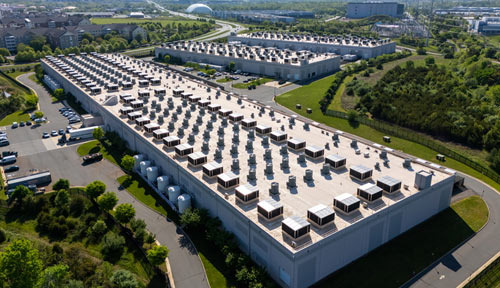
With the surge of artificial intelligence (AI), a fierce competition for large data center construction is underway across the U.S., with major tech companies investing billions of dollars.
However, industry analysis indicates that over 60% of the U.S. data center projects aimed for completion by 2027 are facing delays or difficulties in starting due to a lack of necessary power supply. The pace of expanding the U.S. power infrastructure is not keeping up with the rapid growth of the AI industry.
This issue is not just about rising electricity costs; it has emerged as one of the biggest obstacles in the U.S. competition for AI dominance.
A notable example is Oakley in Northern California. Recently, the city council unanimously passed a measure to suspend land use applications and reviews related to data centers for 45 days. Despite being close to Silicon Valley, residents strongly opposed the increase in power consumption and water scarcity concerns.
Why is this situation occurring?
The first reason is the explosive power consumption of AI servers.
In the past, typical data centers used between 10MW and 25MW of power. However, the latest AI data centers are a completely different story. With thousands of high-performance GPUs operating continuously, some facilities are demanding over 100MW of power.
In simple terms, while previously a small factory might have consumed that much power, now facilities are emerging that consume power comparable to an entire city.
The second reason is the aging U.S. power grid.
The U.S. is the world's largest economy, but many transmission lines and substations were built decades ago. Although recent plans for hundreds of billions of dollars in power grid investments have been announced, it can take years to obtain permits and conduct environmental reviews for even a single new transmission line.
While the AI industry grows in months, the power grid expands over years, inevitably leading to a gap between supply and demand.
The third reason is the excessive concentration in certain regions.
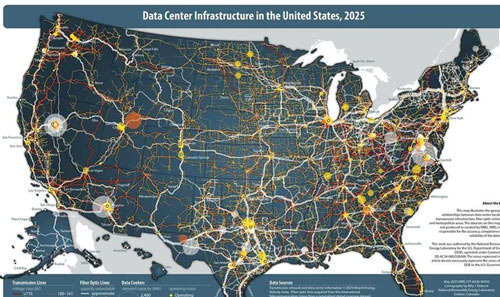
Northern Virginia, the hub of the U.S. data center industry, is known for handling a significant portion of global internet traffic. Along with Texas, Arizona (Phoenix), and Silicon Valley, the concentration of data center construction is pushing the power grid capacity to its limits.
In some areas, there are cases of limiting or postponing new data center power connection applications for several years.
Once, data centers were considered a golden industry that revitalized local economies.
They were expected to bring increased tax revenue, stimulate construction, and create jobs. However, the recent atmosphere is changing.
Residents argue that data centers consume excessive electricity and water while providing minimal benefits to the community. Although thousands of workers are needed during construction, only a relatively small number are involved in operations after completion.
Particularly controversial is the vast amount of water used for cooling. The western U.S. is already struggling with drought issues, and the water used for cooling by data centers is further burdening local water resources.
For these reasons, the U.S. government and big tech companies are showing interest in small modular reactors (SMRs), natural gas power plants, and building their own power generation facilities. In the past, they could rely on electricity supplied by power companies, but now companies must produce their own power.
On the other hand, this crisis is becoming a new opportunity for Korean companies.
The demand for high-voltage transformers, power cables, and substation equipment necessary for expanding the power grid is skyrocketing. Especially, high-voltage transformers have long production times and high technical barriers, leading to a serious global supply shortage.
Korean power equipment manufacturers have already secured several years' worth of orders from U.S. power companies and data center operators. For the U.S. to expand its AI infrastructure, it must first enhance its power grid, and Korean companies are likely to play an increasingly significant role in that process.
Ultimately, the real competition in the AI era is not just about securing a large number of GPUs. The key competitive advantage lies in how reliably electricity can be supplied.
The U.S., once regarded as the biggest beneficiary of the AI revolution, is now facing the harsh reality of power shortages, creating an interesting situation where the Korean power equipment industry is unexpectedly benefiting.
This serves as a representative example showing that the future of the AI industry is determined not only by semiconductors but also by the power grid.
 FixItBros
 CocoChute
 HawaiiTofu







 novapixel |
 Victory 1988 |
 washington mom |

 El Dorado |
 Learn English Accurately |
 Egg Steamed Pot |
 Balancework |
  U.S. Supreme Court Judge Kim |
 My Circle |
  urban legend |
  coolriver |
  Good Neighborhood, Wealthy District Information |
  Ro Ro Car |
  Amber H |
  new sugar |
  Palm 1000 |
  loran |
  donutfield |
  Tennis City |
  sunny7 |
  Questions about firearms while living in America |
  Shoot Me |
  mochifox |
  zucchini |
  Anna Life |
  Exciting FM Radio |
  pet dog |