

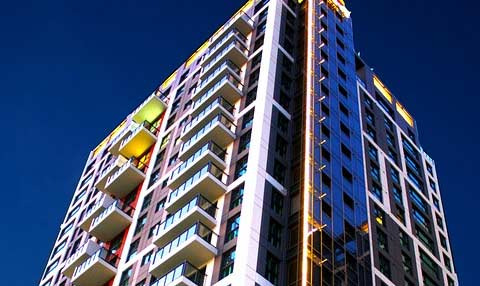
Recently, there has been a boom in high-rise apartment development centered around Koreatown, near downtown LA and Wilshire Boulevard.
Tall buildings with modern and sophisticated exteriors, using hotel-grade finishes for interiors, are popping up everywhere.
At first glance, it seems like our area's skyline is changing and developing, but several serious issues with this trend are becoming apparent.
The first issue is the coexistence of luxury and small units. Nowadays, most newly constructed apartments consist of small units under 500 to 700 square feet.
Units that would not have been called one-bedroom in the past are now labeled as 'luxury micro units' and often exceed $3,000 in monthly rent.
The problem is that these units do not guarantee a quality living experience.
No matter how luxurious the finishes or how great the sky view, the lack of space felt in real life is a stress that cannot be easily ignored.
Additionally, small apartments often have insufficient soundproofing, which can be a significant issue.
It is already common knowledge that older apartments in the LA area have less noise between floors.
Newer apartments are facing significant issues with noise between tenants.
The second issue is that high construction costs are directly passed on to rent.
Labor and material costs in LA have skyrocketed since the pandemic, and now even simple 3-5 story apartments have construction costs per square foot that are through the roof.
On top of that, various city permits, eco-certifications, and parking design requirements add to the complexity... developers find themselves in a structure where they 'have no choice but to raise rents.'
Ultimately, that burden falls squarely on the tenants.
The third issue is that the diversity of housing in the city is disappearing.
As luxury apartments increase, the number of rental homes affordable for the middle class or low-income residents continues to decrease.
In the past, it was possible to find decent one-bedrooms for under $1,500 near Koreatown or K-Town, but now even that is being converted into high-priced rentals under the guise of 'renovation.'
In the end, while the quality of housing may have improved, the number of people who can enjoy those benefits is steadily decreasing.
Finally, there is the issue of community breakdown. Luxury apartments typically target short-term renters, young professionals, and international students.
These individuals do not stay long and do not feel the need to build relationships with neighbors.
On the other hand, long-time residents of existing communities are being pushed out because they cannot afford the rent.
What used to be a Koreatown where neighbors greeted each other in every alley is now becoming isolated living spaces among tower-style apartments.
Many Koreans have left California for Nevada, Utah, Arizona, Texas, Georgia, and South Carolina, and many still wish to leave.
As a real estate professional, I also understand the reasons for the need for luxury development.
Considering land prices, labor costs, and investor return expectations, building affordable rental housing is a realistically difficult structure.
However, if the entire city is filled only with luxury apartments, that city will ultimately transform into a place where only those who can afford to enter can survive.
Now is the time for the private sector and the government to think together and reconsider LA's housing issues not in terms of 'height' but 'breadth.'







 ultron78 |
 garlic bread |
 Sugar Cream Door Bulletproof Noodles |
 urbanmint |
 |
| 
 Weekend Movie Blog |
 Beauty, Health, Lifestyle Blog |
 coloradoman |
 Superman Cat Blog |
 Victory 1988 |
  Korean Mom |
  My NYC |
  moo moo |
  Mr Oh |
  forevergee |
  festival |
  manchester |
  constant |
  Leapfrog Move |
  vibranto |
  Tora Tora |
  yellowbutter |
  Dolly |
  US Embassy |
  NYC saladbar |
  Finding Superfoods |
  lightyear |
  song bang |
  vexomo |
  Indiana Jones |