

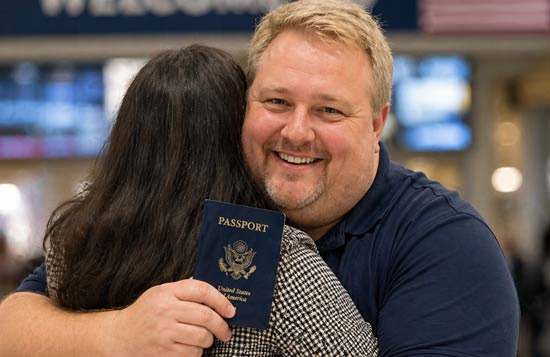
I'm currently 38 years old and still single, but half of my friends are married while the other half, like me, are still single.
Yesterday, my close friend Mike said, "Hey, I might really go to Thailand or the Philippines to find a wife." It was half a joke, half serious.
Mike is a bit overweight, but he graduated from Columbia Law School and works as an M&A lawyer at a law firm in DTLA, earning a decent salary.
However, he said meeting women in LA is exhausting. According to him, it's hard to start a deep relationship based on his looks.
I'm not sure if this friend will actually board a plane to Southeast Asia.
But it's clear that this kind of conversation is no longer just a joke among American men in their late 30s to 40s.
This is the rising phenomenon of "Passport Bros."Interestingly, there was a movement exactly opposite to this 200 years ago.
Mail-Order Brides. The same desire, but in the opposite direction. Today, let's look at these two phenomena together.
First, let's go back in time. The 1620s in Jamestown, Virginia. This was when England was just starting to establish colonies in America.
The problem was that almost all the people gathered there were men.
Soldiers, farmers, adventurers. Without women, society couldn't stabilize. They drank, fought, and ran away. You could think of it like the atmosphere around old military bases in Korea.
The Virginia Company came up with a plan. They recruited marriageable women from England, covered their migration costs, and put them on ships.
Once the brides arrived and married someone, the husbands would repay the migration costs to the company with tobacco.
At that time, tobacco was currency. So these women were called "Tobacco Wives."
It sounds a bit odd, but it was a reasonable transaction by the standards of that time.
For women living in poverty in rural England, the New World was a chance for a new life, and colonial men desperately needed stability in a home.
The next major wave was during the westward expansion from the 1840s to the 1880s.
With the gold rush, men flocked to places like California, Colorado, and Wyoming.
But here too, the same problem existed. There were no women. It was common to find towns with 100 miners and only one woman.
This is when newspaper marriage ads emerged. Lonely men in the West placed ads in Eastern newspapers saying things like, "Sincere farmer seeking a marriage partner. Healthy women aged 25-35 wanted."
Women from the East would send letters, and they would get to know each other through handwritten correspondence for months. Then, if they felt a connection, the woman would take a train for several days to the West.
It was common to meet for the first time on the day of arrival and get married that week. This was faster than matching on dating apps and meeting within a month.
The stories of brides from that time are truly diverse.
There were cases where women arrived only to find a man completely different from the ad and ran away, cases where a forward-thinking businesswoman became wealthier than her husband, and cases where women survived Indian attacks and wrote memoirs.
It's safe to say that half of American Western movies are built on the stories of these women.

Now, let's come to the present. The same desire, but the direction is completely opposite.
This time, men are boarding planes. To Southeast Asia, South America, and Eastern Europe. If you search "Passport Bros" on YouTube, thousands of videos come up.
There are testimonials about meeting "traditional value women" in Thailand, Colombia, the Philippines, and Ukraine.
Their claims are roughly as follows. The American dating market is broken. Women are too picky, have low priorities for marriage and family, and have unrealistic standards for men.
So, they argue, they go to countries where family-centered values are still alive.
Whether this is a backlash against feminism, a real market failure, or just an excuse varies from person to person.
When looking at the countries frequently mentioned in the Passport Bros community, each has a different atmosphere. Let's summarize.Thailand is the oldest destination. Bangkok, Chiang Mai, Pattaya. English is widely spoken, the infrastructure is good, and visas are relatively easy to obtain.
However, since it's been a long-standing market, many women here have a lot of experience with foreign men. It's common to expect a naive country girl and end up meeting a skilled negotiator.
The Philippines has a strong family-centered atmosphere due to its Catholic culture. English is almost a native language, making communication the easiest.
However, once married, there's often an expectation to support 30 family members from the wife's side. This is often the part that shocks American men the most.
Colombia has exploded in popularity in the last five years. It's praised for its warm family culture and good looks typical of Latin America.
However, safety issues and the "gringo price" (overcharging foreigners) are always a concern.
Vietnam, Japan, and Korea fall into a different category. In Korea and Japan, women are already economically independent and have strong doubts about marriage itself.
So, Passport Bros going there surprisingly say they are looking for "quiet women with their own lives." Vietnam is still a country with a strong family-centered culture, making it an emerging popular destination.

However, the situation in Ukraine has become extremely complicated after the war, making it one of the most ethically controversial regions.
Criticism is clear. There are accusations that it's a kind of power transaction exploiting economic disparities.
When an unremarkable man from New York goes to Manila, he suddenly becomes popular not because he's great, but because he has dollars.
And this structure cannot escape criticism for viewing women not as equal partners but as "less picky options."
There are valid points on the advocacy side as well. It's a matter of personal freedom where one finds a marriage partner, and every marriage has economic elements involved, they argue.
Isn't it similar to how lawyers marry lawyers and doctors marry doctors within the U.S.?
That makes sense. However, I believe that when borders and wealth disparities are involved, the nature of the issue changes.
The feelings of an Eastern woman taking a train to Wyoming 200 years ago and a New York lawyer boarding a plane to Manila today are fundamentally similar.
When one feels there are no answers here, humans cross borders. This is a matter of anthropology before it is a moral issue.
However, there are differences. The old mail-order bride system was a product of a desperate social structure.
Today's Passport Bros are a product of dissatisfaction amid abundance. This makes it more complex.
The essence may be an avoidance of self-reflection, or it could be a genuine cultural mismatch.
Marriage is ultimately a matter of not another country, but another person, and to meet that other person well, one must first sort oneself out.
Both the bride who arrived in Wyoming 200 years ago and the groom who arrives in Bangkok today stand before the same truth.







 Arizona AZ Cowboy |
 Valley Hong |
 Mr Oh |
 ollege Mom |
 Helpful Life Stories |
 Weekend Movie Blog |
 Superman Cat Blog |
 Beauty, Health, Lifestyle Blog |
 prixon74 |
  Soft Feeling That Feeling |
  assa man |
  Yugo Girl I'm So Hot |
  nexaro |
  Experiences Living in America |
  arsnack |
  Nebraska Center Director TOP |
  Florida Gario |
  menmo |
  springw |
  Woooooah |
  frostpup |
  chocopup |
  Angeles Choi |
  My Heart Popper |
  comova |
  vintago |
  Sky Way |
  Top Beaches |