

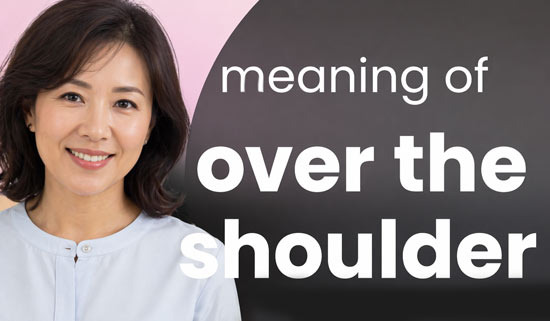
Let me share some expressions that include the word "shoulder," like "over the shoulder," which you often hear in English conversation.
If you understand just this one, you'll be able to say you know some English when you go out!
First, looking at "over my shoulder," it means 'over my shoulder,' but when you say "keep looking over my shoulder," it gives a feeling of anxiety or being on guard against someone.
For example, if you say "I kept looking over my shoulder," it doesn't just mean you glanced back a few times; it indicates that you're constantly worried and anxious about whether someone is following you.
Additionally, there's the phrase "someone is looking over my shoulder," which is often used to mean that someone is watching what I'm doing from behind me.
It usually gives a feeling of being monitored. It's really uncomfortable when your boss is right behind you watching you work.
In that case, saying "I hate it when my boss looks over my shoulder" fits perfectly.
Also, to say "I learned it over someone's shoulder" means 'I learned it by watching someone.'
This implies that you didn't have someone teach you directly, but you learned by casually observing from the side.
For example, if you say "I learned Photoshop over my colleague's shoulder," it gives the impression that you learned by watching your colleague.
To say it more naturally, you can also use the phrase "I picked it up by watching." This is much more commonly used in everyday conversation.
Another expression you should definitely know is "a chip on my shoulder."
This expression doesn't make sense if you translate it literally, but it means 'being unnecessarily sensitive and ready to pick a fight.'
It's like someone who has built-up resentment and reacts immediately if someone touches on that.
You would say, "He's got a chip on his shoulder" about such a person.
"Shoulder to shoulder" is also frequently used. This phrase has a stronger connotation of 'joining forces together.'
For example, if you say "We stood shoulder to shoulder," it implies that you endured together as a team. This is often used in discussions about sports or war.
When you say "a weight off my shoulders," it means 'a big burden has been lifted, making me feel lighter.'
For example, if you say "It feels like a weight off my shoulders," it gives the feeling of relief as if a load has been taken off your shoulders. This is easily understood in Korean as well.
a weight off my shoulders → burden is lifted
take a weight off my shoulders → relieve a burden
get something off my shoulders → put down a burden/responsibility
Another expression you often hear in real life is "give someone the cold shoulder."
This means to treat someone coldly and ignore them on purpose. If you say "She gave me the cold shoulder," it describes a situation where someone deliberately avoids talking to you and keeps their distance.
Finally, there's the expression "shoulder the responsibility," where 'shoulder' is used as a verb.
This means 'to take on responsibility.' If you say "He had to shoulder all the blame," it means he took on all the responsibility by himself.
Looking at all this, you can see how the word 'shoulder' can express emotions, relationships, and situations.
In English, it's common for body words to be used in this way. Therefore, it's much more important to learn how words are used in actual situations rather than just memorizing their meanings.
Using just a few of these expressions naturally can make your English feel much more alive. I'll let you know if I come across more interesting expressions next time.
 SambaDancing






 ollege Mom |
 Helpful Life Stories |
 prixon74 |
 Balancework |
 Make My Day |
 Baguette Blog |
 Coco and Lulu |
 Snack-like Blog Writing |
 Until the Day It Gets Better |
  urban legend |
  coolriver |
  Good Neighborhood, Wealthy District Information |
  Ro Ro Car |
  Amber H |
  new sugar |
  Palm 1000 |
  loran |
  donutfield |
  Tennis City |
  sunny7 |
  Questions about firearms while living in America |
  Shoot Me |
  mochifox |
  zucchini |
  Anna Life |
  Exciting FM Radio |
  pet dog |
  toodin |
  rosed |