

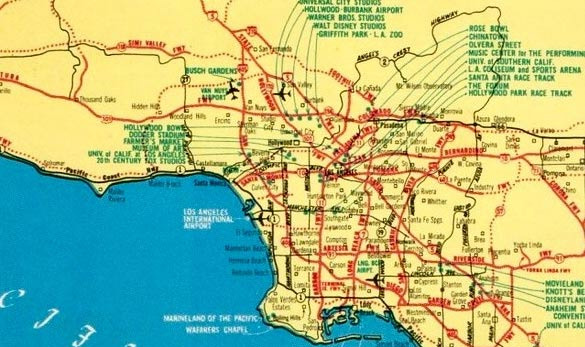
One of the things that confuses newcomers to LA is the concept of administrative divisions.
It's easy to think, isn't it all just LA? However, the LA area is actually made up of a very complex administrative system.
Los Angeles County, the City of Los Angeles, and 88 incorporated cities coexist.
Understanding this difference affects many aspects of daily life, such as address notation, taxes, school assignments, and local services.
First, you need to know about Los Angeles County.
Los Angeles County is the most populous county in the United States, with about 10 million residents. It covers an area of 4,084 square miles, larger than the entire state of Rhode Island.
Los Angeles County is governed by a Board of Supervisors, which consists of 5 supervisors. The county is divided into 5 electoral districts, each overseen by a supervisor. The county provides services directly to unincorporated areas, while incorporated cities manage their own administrations.
There are 88 incorporated cities within Los Angeles County.
Agoura Hills, Alhambra, Arcadia, Artesia, Avalon
Azusa, Baldwin Park, Bell, Bell Gardens, Bellflower
Beverly Hills, Bradbury, Burbank, Calabasas, Carson
Cerritos, Claremont, Commerce, Compton, Covina
Cudahy, Culver City, Diamond Bar, Downey, Duarte
El Monte, El Segundo, Gardena, Glendale, Glendora
Hawaiian Gardens, Hawthorne, Hermosa Beach, Hidden Hills, Huntington Park
Industry, Inglewood, Irwindale, La Cañada Flintridge, La Habra Heights
La Mirada, La Puente, La Verne, Lakewood, Lancaster
Lawndale, Lomita, Long Beach, Los Angeles, Lynwood
Malibu, Manhattan Beach, Maywood, Monrovia, Montebello
Monterey Park, Norwalk, Palmdale, Palos Verdes Estates, Paramount
Pasadena, Pico Rivera, Pomona, Rancho Palos Verdes, Redondo Beach
Rolling Hills, Rolling Hills Estates, Rosemead, San Dimas, San Fernando
San Gabriel, San Marino, Santa Clarita, Santa Fe Springs, Santa Monica
Sierra Madre, Signal Hill, South El Monte, South Gate, South Pasadena
Temple City, Torrance, Vernon, Walnut, West Covina
West Hollywood, Westlake Village, Whittier
Among these, the City of Los Angeles is the largest, covering 503 square miles and with a population of about 3.9 million.
The City of Los Angeles is divided into 15 City Council Districts, with each council member representing local issues.
Koreatown, which has a large Korean population, is located in District 10. The Mayor represents the entire city, and currently, Karen Bass is in office.
It's also good to know about major independent cities that are outside the City of Los Angeles but within Los Angeles County.
Beverly Hills, Culver City, and Santa Monica are independent cities located like islands within the City of Los Angeles.
Burbank, Glendale, Pasadena, Torrance, and Long Beach are independent cities that border the City of Los Angeles.
These cities operate their own police, fire, and school systems, separate from LA.
For example, the Beverly Hills Police Department (BHPD) operates within Beverly Hills and is not under LAPD jurisdiction.
Koreatown, where many Koreans reside, is administratively located within the City of Los Angeles and falls under District 10.
Koreatown is not a separate independent city but a neighborhood within the City of Los Angeles.
The boundaries of Koreatown are generally considered to be between Western Avenue and Vermont, and from Olympic Boulevard to Beverly Boulevard, but the official boundaries are set more complexly.
The official administrative organization for the Koreatown neighborhood, the Koreatown Neighborhood Council, is also active.
Understanding administrative divisions is important for various reasons in daily life. School assignments are determined by school district boundaries, not by the city of residence.
Services like trash collection and road maintenance depend on whether the area is within the City of LA or a separate city.
Voting also differs between city and county elections. Knowing exactly which administrative area you belong to makes accessing public services much more convenient.
 DeskiuAme
 BootedPizza





 moo moo |
 ultron78 |
 garlic bread |
 Sugar Cream Door Bulletproof Noodles |
 urbanmint |
 Weekend Movie Blog |
 Beauty, Health, Lifestyle Blog |
 Victory 1988 |
 coloradoman |
 Superman Cat Blog |
  lumbus |
  Texas Migration Story |
  Scade Studio |
  love ya |
  biscuit90 |
  chicpo |
  Helpful Life Stories |
  Kitchen Ideas |
  Diana Blues |
  Agenda Center |
  Community Cross |
  journey |
  heeve |
  leman |
  corner kick |
  treasure |
  strawberry |
  Augusta Univ |
  B.I.G. Victor |