

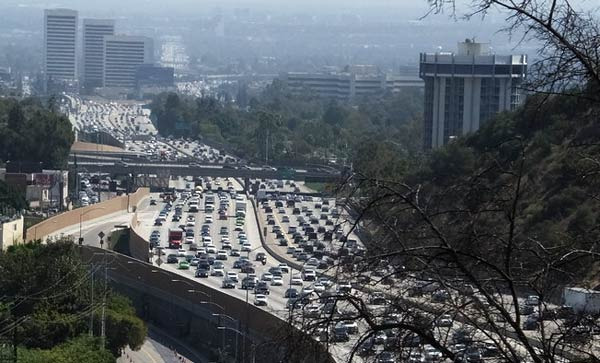
The story of LA traffic, famous for its congestion in America, is now a form of stress that has permeated daily life.
But what happens when it rains, like this week? The already sluggish traffic flow comes to a complete standstill.
The saying "LA people can't drive when it rains" is half a joke and half the truth. When you get on the 405, 10, 5, or 101 freeways on a rainy day, you immediately feel why LA is one of the 'worst traffic cities in the world.' It's slow on normal days, but when it rains, cars are just parked on the freeway like a parking lot while they watch the news of continuous accidents.
This problem is not just Southern California's issue. The entire United States is suffering from traffic congestion again. The statistics are shocking: in 2024, Americans wasted an average of 63 hours in traffic jams. To put that in perspective, it means being stuck in a car for two full days and 15 hours.
Of course, the term 'driving' can often feel embarrassing. In reality, while drivers are sitting down, their cars hardly move, and they spend time yawning, listening to streaming radio, cursing traffic apps, and discreetly checking their phones to avoid getting caught by the police.
The problem is that the rate of deterioration is too fast. As remote work increased during the pandemic, the once-empty roads suddenly became congested again, and in some areas, traffic is worse than before the pandemic.
Moreover, people continue to move into LA, and the new developments, commercial facilities, and logistics centers further stimulate road demand. However, the road infrastructure is stagnant. The measures LA has proposed to solve traffic? Dedicated bus lanes, expanded bike paths, futuristic public transport plans... They sound good, but the city's problems have already grown too structurally large. It's like giving a painkiller for acute pain.
The reason LA traffic is more frustrating is not just because it gets "stuck" but because it is unpredictable. A route that takes 30 minutes today might take 1 hour and 40 minutes tomorrow, and a normally uneventful commute or delivery task can turn into hell or heaven.
Drivers now check real-time traffic conditions as part of their daily routine, and the changing colors of the blue and red lines on their navigation or Google Maps, along with news of accidents ahead, can swing their moods. Rain only exacerbates that situation.
However, there are a few potential solutions to address LA's traffic issues.First, increase investment in public transport. While the Metro lines are expanding, the speed is too slow. A significant increase in regional rail and express bus networks is necessary to reduce car dependency.
Second, expand mixed-use development. This means placing jobs, housing, and commercial facilities closer together to reduce long-distance commuting.
Third, implement congestion pricing. Charging fees for entering core areas, like in London and Singapore, actually reduces vehicle volume.
Finally, expanding remote work is the most realistic solution. The fact that roads were suddenly empty during the pandemic shows that the answer is already out there. Complete resolution may be difficult, but a 'less painful LA' is certainly possible.
The problem lies in the vision and willingness of politicians to solve these issues... I won't say more.
In the end, LA traffic is a problem we didn't want but will have to endure.






 Weekend Movie Blog |
 Beauty, Health, Lifestyle Blog |
 coloradoman |
 Superman Cat Blog |
 Noodle Noodle |
  Tonky |
  viroma |
  cookie |
  Live and that's it |
  Alright Twain |
  eatontown blog |
  HAWAII Korean Church News |
  Amore |
  linex |
  Balancework |
  laro90 |
  MEDBIO American Doctor Blog |
  SWAT TEAM BLK |
  DREAM BIG |
  frostbite |
  330 Forever My Love |
  El Dorado |
  dralix58 |
  Gorama Round |
  Skydiving |