

These days, when people talk about autonomous driving, they often mention Tesla first.
But honestly, Tesla's FSD is still not quite at the level to be called "fully autonomous driving."
Even Elon has somewhat acknowledged in the media that the claims of full autonomy might be exaggerated.
In the meantime, Amazon acquired Zoox for about $1.2 billion in 2020. And for five years, they did almost nothing.
The name Zoox might sound a bit silly, but the lack of action is concerning.
When big tech companies like Amazon are quiet, it usually means they are sharpening their knives.
Last year, the Amazon Zoox robo-taxi service finally launched for the public in Las Vegas.
When I first saw this news, one thing immediately stood out to me. This is not just an autonomous vehicle; it's an autonomous transportation system.
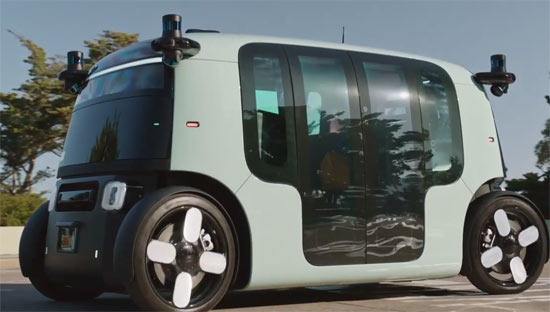
There are other autonomous robo-taxis like Waymo and Cruise.But Zoox is different. There's no steering wheel. There are no pedals. There's no driver's seat at all. The seating is arranged to face each other, and the doors are sliding.
At first glance, it looks more like a wheeled capsule than a car.
This may seem like a simple design difference, but it represents an approach of "not just adding autonomy to a car" but "creating a vehicle for autonomy from scratch." This vehicle is designed from the ground up with a 0% chance of human driving.
It has cameras, LiDAR, radar, and even infrared cameras. It offers 360-degree full coverage.It is said to be able to detect human body heat even in the dark. With this level of sensor layering, most edge cases are covered.
If Zoox were just a startup, it would have ended up as "an interesting robo-taxi company."
But when Amazon is involved, the story changes completely.
Think about Amazon's logistics network. Millions of packages are moving around cities every day.
Delivery driver labor costs, vehicle maintenance costs, accident risks. These are all expenses. If fully autonomous vehicles are added to this, the calculations change completely.
Furthermore, during times without passengers, they can be used for deliveries, and during delivery times, they can transport passengers. This creates a structure where a single vehicle can operate at 100% capacity all day long. A hybrid of taxi and delivery truck. This is the vision Amazon has.
The four-seat structure facing each other didn't just come about by chance. It's designed for a ride-share model that picks up passengers with similar destinations simultaneously, operating like a small minibus. They aim to create a new category somewhere between taxis and buses.
Thinking that autonomous driving is perfect is a mistake. Traffic regulations vary by city, and regulations are constantly changing.What works well in one city may not work in another right away. Whether it will actually be price competitive is still uncertain.
Tesla marketed autonomous driving, and Waymo experimented with it.
Zoox designed autonomous driving as infrastructure. We need to see how much this difference will grow in 5 or 10 years.
There's always a reason when Amazon moves quietly. It was the same when AWS came out and when Prime changed the logistics game.
Zoox could be the next chapter. I believe the attempt to fundamentally change urban mobility has already begun.
 SandwichSurf



 Breaking Bad Drama |
 Coastal city |
 novapixel |
 Victory 1988 |
 washington mom |
 vegas mom |

 US Legal Consultation on Trials |
 zanero |
 neroyo |
  Maria Mom |
  Watch for possible danger |
  northpeak |
  Far East Movement |
  Light of the World |
  mariashin |
  lavender |
  Bridgo |
  Tamfa Fan |
  Sunny Sunday |
  mini hometown |
  torvia |
  Chichiki Chicago Train |
  Univ Student |
  See It |
  Con Cheese |
  softmoony |
  New York Queens Native Blog |
  Shinbaram Dr. Blog |