

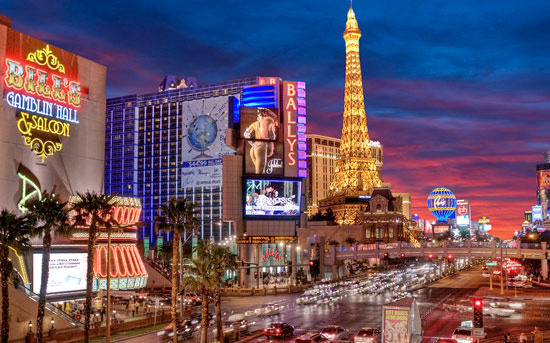
These days, discussing Las Vegas feels ambiguous—it's unclear whether things are getting better or worse.
On the surface, everything seems fine. Planes continue to bring people into the airport, and every weekend features major concerts, sports events, and even F1 races. During busy weekends, the entire city is packed. Tourists keep coming, and the casino lights never go out.
From this perspective, it seems accurate to say, "It's still thriving."
However, looking closer, people are coming but not spending money. To be precise, they can't spend it.
Why? Because prices have skyrocketed.
Hotel rates, food prices, show tickets—everything has gone up. Not just a little, but absurdly high.
In the past, a hotel in the middle of the Strip could be found for around $100 during the week. Now, the same room costs $250 or $300.
With resort fees and parking charges, $400 can disappear before you even check in.
Food prices are even worse. At any restaurant inside a casino, a steak costs $60 or $70, and a glass of wine is $25.
This is not even a Michelin-starred restaurant, just an ordinary hotel eatery.
Tourists aren't foolish. If they come to a city to spend money but are forced to calculate expenses first, what happens?
Their stay shortens. A 3-day, 2-night trip becomes 2 days, 1 night.
They skip dinner and head to the food court. Instead of buying show tickets, they watch the free fountain show.
In fact, analyses show that the influx of international tourists has decreased. Consumers within the U.S. are also opening their wallets less.
Las Vegas is ultimately a "city where people come to spend money." If people come but don't open their wallets, the structure is shaken.
The key point here is that Las Vegas is directly influenced by the U.S. economy.
No, it's not just influenced; it amplifies those effects.
When the economy is good, Las Vegas is one of the first places to thrive. People travel, gamble, and see shows with their disposable income.
Conversely, when the economy falters? Las Vegas is also one of the first cities to feel the impact. Travel and entertainment expenses are among the first items households cut back on.
In simple terms, when signals come in, they resonate loudly—both positively and negatively.
So, what about the current U.S. economy? The GDP numbers look decent, but the on-the-ground experience is different.
The cumulative impact of inflation is significant. Low-income and middle-class individuals are already maxing out their credit cards.
In this situation, how many people would book a flight to Las Vegas and reserve a hotel?
Real estate signals are also mixed. Let's look at the industrial real estate sector. Supply has increased, but demand hasn't kept pace. Vacancies are piling up. During the e-commerce boom, warehouses were built at a crazy pace, but that speed has now slowed.
Interestingly, investment transactions are starting to increase again. This means the market isn't dead.
Prices have dropped, so there are buyers emerging. It indicates that the market direction is changing.
The office market is even more dramatic. Due to the impact of remote work, vacancy rates continue to rise. Some buildings are being converted for different uses. This isn't just a simple economic cycle; it's a structural change. This isn't just a problem for Las Vegas; it's a trend across the entire U.S.
What's interesting is that the no-tax-on-tips policy benefits service-oriented cities like Las Vegas significantly.Bartenders, dealers, hotel housekeeping staff, servers, valets, and showgirls working in Las Vegas all rely on tips.
In many cases, tips account for more than half of their income. And where does this money go? Right back into the local economy. Service workers tend to spend rather than save.
So, while this policy is a positive factor, it's not a cure-all.
In my view, Las Vegas is neither on the rise nor in decline right now. It's in the process of determining its direction.
As the national economy recovers and inflation is controlled, Las Vegas will bounce back. It's an amplifier.
Conversely, if consumer contraction deepens, the city will shake even faster and harder due to its nature as a tourist destination. Again, it's an amplifier.
If you only look at the visible neon lights and events, you might think, "It's still okay." But when you look at the numbers and trends, the story is different.
The true state of this city is neither "doing well" nor "failing."
As of mid-April 2026, it seems to be exactly in the middle, at a crossroads.





 Make My Day |
 viroma |
 eatontown blog |
 Toaster Pizza Magic Show |
 US Embassy |
 neroyo |
 Folding Instructions |
 Say IT Now |
 celion78 |
 phoenixia |
  viewtop |
  loverun |
  Kim Do Sun |
  SEVEN SEVEN |
  yentra |
  Victory 1988 |
  Tonky |
  cookie |
  Live and that's it |
  Alright Twain |
  HAWAII Korean Church News |
  Amore |
  linex |
  Balancework |
  laro90 |
  MEDBIO American Doctor Blog |