

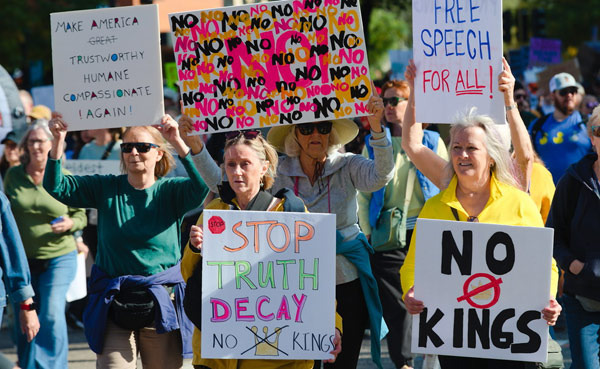
Last week, there was a lot of talk about the 'No Kings' protests that took place simultaneously across the United States.
People held signs opposing President Donald Trump and collectively shouted, "No Kings, there are no kings."
In terms of scale, over 3,300 gatherings were held, with participation estimated at more than 8 million people.
This protest saw participation grow from about 5 million in June last year to around 7 million in October, surpassing 8 million this time.
The scale continues to grow, and it can be seen as a culmination of citizens' accumulated dissatisfaction, especially in light of the recent war in Iran.
The epicenter of this protest was Minnesota, the site of a shooting by Immigration and Customs Enforcement agents in January that resulted in the deaths of two citizens. This incident acted as a symbol of anger and served as a catalyst for the spread of protests.
At the New York Manhattan rally, actor Robert De Niro made an appearance, drawing attention. He strongly criticized the administration, stating, "Trump must be stopped."
However, despite millions taking to the streets, the White House's response was quite light and dry.
They assessed it as a protest created by a "leftist funding network" and claimed that public support was not significant.
While millions participated, the interpretation of the event seems to be completely opposite. It gives the impression that two entirely different realities are being observed.
The timing is also peculiar. The day before the protest, President Trump stirred controversy by referring to the Strait of Hormuz as the 'Trump Strait.'
However, on the day of the large-scale protest, he did not appear in public. Iron barricades were set up around the White House, and the lights inside the building were off. The only place he was spotted was at a golf resort in Florida. This single scene seems to encapsulate the situation.
Current approval ratings are also on the decline. Ahead of the November elections, they have dropped to about 36%, the lowest since taking office.
However, whether this decline in approval ratings will lead to policy changes is a separate issue.
Personally, I wonder what has actually changed despite such large-scale protests.
No policies have been revoked, the risk of war has not been alleviated, and the power structure has not been shaken. There are still no clear changes that can be felt.
Recent protests are characterized by growing scale but increasingly minimal results. Citizens' anger is certainly present, and the reasons are sufficient, but the strategy for translating this into concrete change is still unclear.
This protest took place not only in the U.S. but also simultaneously in over 12 countries, including South America and Australia.
It has spread as a global movement. Nevertheless, the world continues to move along its existing trajectory. News quickly shifts to other issues.
Ultimately, one question remains: "So what was gained?"
Records, videos, and the atmosphere remain. However, if reality does not change, it becomes ambiguous whether it is merely an event for emotional expression.
Looking at the current situation, many people are raising their voices, but the direction remains unclear.
They are gathering more and shouting louder, but the subsequent direction or steps are not visible. It feels uncertain whether it will impact the elections.
However, this 'No Kings' protest will certainly be remembered for its "unprecedented scale."
Yet, there is still no clear answer to the question, "So what has changed?"





 Encyclopedia of New York and Surrounding Areas |
 washington mom |
 California Dreamer |
 Sugar Cream Door Bulletproof Noodles |
 Investment Campus Home Ownership |
 Minnesota Lakes and Clouds |
 licoril |

 chiobase |
  Healthy Local Fresh Information |
  molten |
  Way to easy |
  intact |
  Always Dreaming of Big Success |
  happy 9 |
  Park M.Y. |
  tredon |
  Poppin News |
  metsoo |
  dewyo |
  Casa Mia |
  Asparagus Blog |
  dorange |
  hiddenkong |
  some fame |
  Godory Life |
  Lime Juice |
  French fries |
  Rynex |