

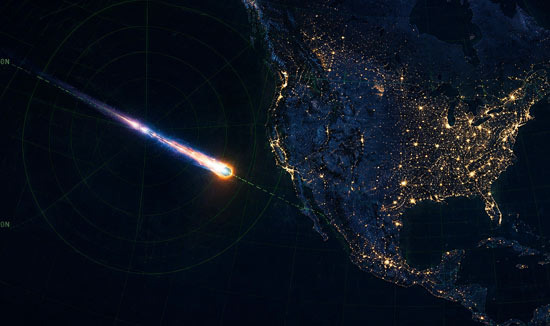
These days, headlines like "Another Asteroid Approaching" are no longer unfamiliar. The warnings often state a less than 1% chance of collision in about 30 years.
In the past, this news would occasionally make it to international headlines, but now it feels like it comes up at least once a month.
This reflects not so much a real danger but rather advancements in observation technology. We are now capturing more small celestial bodies that might have been missed in the past. As our ability to observe the sky improves, the amount of information has increased.
However, this repetitive exposure to news can cause psychological anxiety among people.
Today, the news reported that the asteroid 2026 JH2 is estimated to be about 15 to 30 meters in diameter and approached Earth at a distance of about 56,000 miles.
This distance is roughly a quarter of the way to the Moon, which may seem quite close numerically. However, in astronomical terms, it is considered a safe distance, and the actual likelihood of a collision has been analyzed as nonexistent. This asteroid has an 'Apollo-type' orbit, which overlaps with Earth's orbit, leading to such close passes occurring periodically.
The issue lies in the perception formed by these repeated cases. Historically, there have been instances where relatively small celestial bodies have caused actual events.
The meteor explosion in Chelyabinsk, Russia, in 2013 involved a body about 20 meters in size exploding in the atmosphere and creating a shockwave. This resulted in broken windows and over 1,000 injuries. However, this was an event that caused damage on a city scale, not a threat to the entire planet.
The Tunguska event of 1908 is another frequently mentioned case. This explosion in Siberia had enough power to knock down millions of trees, but because it occurred in a sparsely populated area, it did not lead to large-scale casualties. If a similar event had occurred over a major city, the outcome would have been entirely different.
Realistically, the most concerning size range is medium-sized asteroids, between 20 and 100 meters in diameter. These bodies have the potential to cause damage on a city scale. If one were to fall in an urban area, it could result in significant destruction. However, it is said that only about 1.5% of the Earth's surface area is populated, which lowers the probability.
On the other hand, the massive asteroids, several kilometers in diameter, known to have caused the extinction of the dinosaurs, have mostly been located, and the likelihood of them appearing suddenly in the short term is assessed to be very low. Rather, medium-sized bodies are relatively smaller, which means they could be detected later.
Fortunately, there is currently an international monitoring system in place. Various agencies, including NASA and the European Space Agency, are continuously tracking near-Earth objects, and experiments to change asteroid orbits have been successfully conducted.
The current situation is more accurately interpreted as an increase in information rather than an increase in risk. We are encountering more because we are discovering more.
However, it does seem true that the perceived risk has increased due to the repetitive news coverage.
 OceanDre
 DalgonaHelmet







 Encyclopedia of New York and Surrounding Areas |
 washington mom |
 California Dreamer |
 Sugar Cream Door Bulletproof Noodles |
 Investment Campus Home Ownership |
 Margarine Daebimama |
 eatontown blog |
 Google Idea |
 Kim You Shin |
 postcard |
  Let's Be Like a Salt-like City Person |
  Belgray Miscellany |
  sweetvan |
  Augusta Univ |
  Round and Round Children's Song Kingdom |
  butter 90 |
  Lando Mao |
  Washington Denzel DJ |
  LIZ Legal Information Blog |
  vegas mom |
  Sandiego Auntie |
  Premium Gas Camp |
  Things to know |
  TEXAS Fishing Boat |
  AUTO OK |
  aaoaa |
  Florida King |
  Study Abroad Life Know-How Tips |
  Conflite Teacher |