
When thinking of the Mississippi River, most people envision the landscapes of the southern United States.
Scenes like steamboats passing through swamps and young Huckleberry Finn embarking on adventures on a raft come to mind.
In fact, the Mississippi River flows much further north, gracefully passing through Minneapolis.
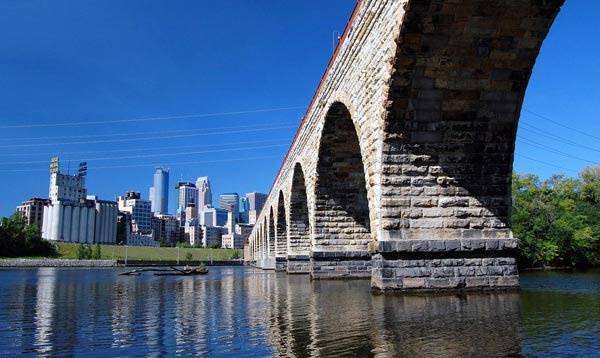
The river, flowing beneath the Stone Arch Bridge in Minneapolis, appears young, wild, and vibrant.
Here, the Mississippi is still a northern river with rich oxygen and low water temperatures before it flows into the Gulf of Mexico.
The river width in the Minneapolis section averages 500 to 600 feet, with a typical depth of 15 to 30 feet, but the riverbed is rocky, leading to significant changes in depth and surprisingly fast currents.
Especially near the Stone Arch Bridge, the St. Anthony Falls is right next to it, causing the water flow to crash down powerfully. Below the falls, whirlpools form, and mist rises, creating a cool breeze even in summer.
In fact, this waterfall allowed Minneapolis to grow into a city. In the late 19th century, waterwheels were powered by the drop of this waterfall to operate mills and factories. The water of the Mississippi essentially drove the city's industry.
Even now, looking from beneath the bridge, you can see the gray rock layers carved by the river cutting through the cliffs. The water is cold, but it holds power. In winter, thick ice forms on the river, while water continues to flow beneath it. The surface is calm, but the river in the north is constantly moving beneath.
The color of the river also changes with the seasons. In spring, it becomes murky with melted snow, in summer it takes on a green hue, and in autumn, it sparkles golden under the sunlight. At sunset, looking down at the river from the Stone Arch Bridge, the city lights reflect on the waves, making the river feel like a mirror reflecting the city.
The Mississippi is not just a place where water flows; it feels like a space that lets time flow by. If Huckleberry Finn's river was a story of a boy's growth, the Mississippi in Minneapolis is a story of the city's growth. It was the starting point where industry was born, bridges were built, and people began to gather and live.
Listening to the sound of the flowing river beneath the bridge for a moment during a busy day washes away distracting thoughts. Perhaps that's why the people of Minneapolis regard the Mississippi River not just as nature, but as a kind of meditation space. Along the riverside paths, there are always joggers, art students, and young men playing guitar.
Everyone spends their time against the backdrop of the river. However, this river is not always peaceful. When heavy rain falls, the river level can rise suddenly by more than 5 to 6 feet, and the current can become strong enough to cover the area beneath the bridge. At such times, the river roars like a massive beast.
Then, after a few days, it calms down again, flowing quietly as if nothing had happened. That appearance resembles a person's life. A river flowing with calmness and explosion, peace and passion. While in the south it symbolizes a leisurely rhythm of life, the Mississippi in Minneapolis symbolizes will and vitality.
Thus, the Mississippi River penetrates the heart of America, conveying the cold breath of the north to the warm sea of the south. In the waters viewed from beneath the Stone Arch Bridge in Minneapolis, time, stories, and the lives of people flow together.








 ultron78 |
 garlic bread |
 Sugar Cream Door Bulletproof Noodles |
 urbanmint |
 |
| 
 Minnesota Lakes and Clouds |
 quatspace |
 U.S. Weather Bureau News |
 chiobase |
  Korean Mom |
  My NYC |
  moo moo |
  Mr Oh |
  forevergee |
  festival |
  manchester |
  constant |
  Leapfrog Move |
  vibranto |
  Tora Tora |
  yellowbutter |
  Dolly |
  US Embassy |
  NYC saladbar |
  Finding Superfoods |
  lightyear |
  song bang |
  vexomo |
  Indiana Jones |