

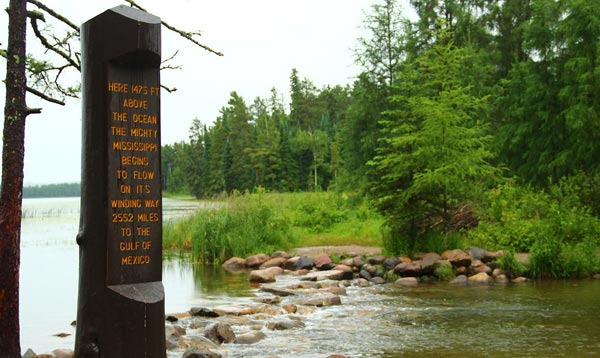
The source of the Mississippi River is Lake Itasca in northern Minnesota.
The name also comes from an Indian word meaning 'true head (Veritas Caput)', symbolizing 'the starting point of the river'.
On the map, it is about a four-hour drive northwest from Minneapolis, roughly 200 miles away, in a land of forests and lakes that nearly borders Canada. The first person to find this place was an explorer named Henry Schoolcraft in 1832.
He was sent by the government to find the source of the Mississippi River and arrived at Lake Itasca while exploring the area with several Native American guides. Until then, people vaguely believed that the Mississippi River flowed in from somewhere in Canada, but when Schoolcraft declared this lake as "the true starting point of the Mississippi River", history was rewritten.
Lake Itasca is not very large. It is about 1.8 miles long and 1 mile wide, resembling a quiet rural lake. However, it is fascinating to think that the water flowing from this small lake travels 2,340 miles to reach the Gulf of Mexico.
At the point where the river begins from the lake, there is a narrow gravel bed and shallow waterway, where tourists in the summer take off their shoes to cross and take photos saying, "I crossed the Mississippi River." The water is only knee-deep, so children can easily cross as well.
Itasca State Park is the oldest state park in Minnesota, established in 1891. It is a vast nature reserve covering about 32,000 acres, featuring dense pine forests and over 100 large and small lakes.
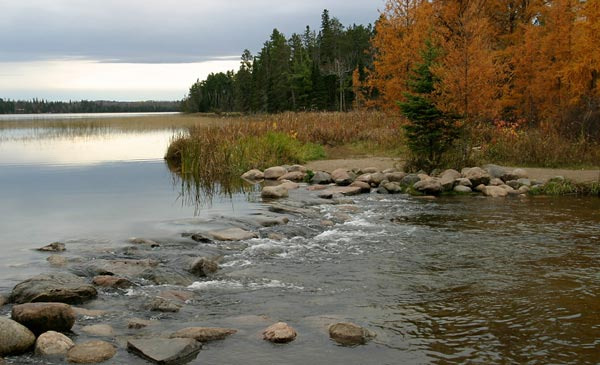
Within the park, there are 400-year-old red pine trees, and in the summer, wildlife such as deer, bears, otters, and eagles can be easily spotted.
In winter, many people enjoy cross-country skiing along the snow-covered forest trails. This place is not just a tourist destination but a natural textbook where one can feel the beginning of the Mississippi River.
Interestingly, when the Mississippi River starts from this lake, it is less than 10 feet wide, but by the time it reaches the Gulf of Mexico, it expands to over a mile wide. In other words, this small forest lake is the birthplace of a massive lifeline that runs vertically across the United States.
The water flowing from Itasca passes through the wetlands of northern Minnesota, goes through Minneapolis and St. Paul, and travels through Wisconsin, Iowa, Missouri, Illinois, Kentucky, Tennessee, and Louisiana before finally entering the Gulf of Mexico.
It is a 'waterway' connecting the agricultural areas, industrial regions, and urban heart of the American Midwest. Therefore, the Mississippi River is not just a river but a great artery that connects the history, culture, and economy of the United States. The name of the river itself is interesting, as it comes from the Ojibwe language, meaning "Misi-ziibi" or "Great River". This symbolism is also why the Mississippi River frequently appears in American literature and music, especially in blues and folk music.
The river mentioned in Mark Twain's 'The Adventures of Huckleberry Finn' is this Mississippi River. When you visit Lake Itasca, you might wonder, 'Is this really the beginning of the great Mississippi?' It is so quiet that you can only hear the sound of birds and the rustling of leaves in the wind. The first step of the Mississippi River is very small and quiet, but its end is vast and magnificent.





 candytip |
 Gold Bar |
 Pirate Ship Popcorn Maker |
 Montgomery Mom |
 Anjollinya Blog |
 Minnesota Lakes and Clouds |
 quatspace |
 chiobase |
 U.S. Weather Bureau News |
  Tonky |
  viroma |
  cookie |
  Live and that's it |
  Alright Twain |
  eatontown blog |
  HAWAII Korean Church News |
  Amore |
  linex |
  Balancework |
  laro90 |
  MEDBIO American Doctor Blog |
  SWAT TEAM BLK |
  DREAM BIG |
  frostbite |
  330 Forever My Love |
  El Dorado |
  dralix58 |
  Gorama Round |
  Skydiving |