

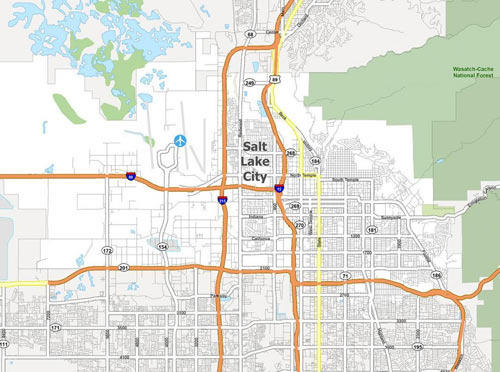
One of the most fascinating things for newcomers to Salt Lake City is its address system.
Instead of the common addresses like "123 Main Street" found in other American cities, you often see formats like "1300 South 145 East."
At first glance, it can be confusing whether it's an address or coordinates. I initially thought it would be impossible to drive without a navigation system.
However, once you get used to it, your perspective changes completely. Salt Lake City is designed with a sophisticated grid system, making the addresses themselves serve as a map. Once you're somewhat familiar, you can estimate locations just by looking at the address.
This unique structure is also tied to the history of Salt Lake City.
When the city was designed, Mormon pioneers systematically laid it out with Temple Square as the reference point.
Even today, most addresses indicate directions and distances from Temple Square as the origin point.
Thus, East, West, North, and South naturally appear in the addresses.
For example, 1300 South means it's about 13 blocks south of the origin, and 500 East indicates it's about 5 blocks east.
Locals can immediately recall the approximate location just from these numbers. It may seem strange at first, but it's actually a very efficient system.
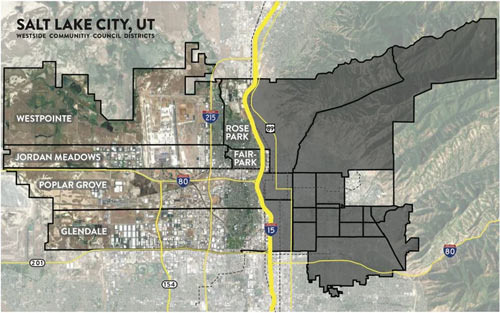
The administrative structure is also interesting. Salt Lake City is divided into seven city council districts, with council members elected for each district.
Additionally, various community councils operate in different areas, fostering a culture where residents actively participate in local issues.
Issues like transportation, park development, and housing policies often reflect the opinions of the residents.
Each neighborhood has a distinctly different atmosphere. One of the most famous upscale residential areas is The Avenues.
Located on the northeast hills of downtown, it features beautiful historic homes. Houses built in the late 1800s and early 1900s are well-preserved, and it's considered one of the most expensive areas in Salt Lake City. The city views from the hills are also stunning.
A popular area among young people and professionals is Sugar House. It has coffee shops, brunch restaurants, independent bookstores, and local shops, making it one of the liveliest neighborhoods in Salt Lake City. It's also known for its relatively progressive culture.
Capitol Hill is another area not to be missed. This region is home to the Utah State Capitol, and the cityscape viewed from the hill is very impressive. On clear days, you can even see the Great Salt Lake in the distance.
Moving east, you come to the East Bench area, formed along the foothills of the Wasatch Mountains. It boasts excellent natural surroundings and is home to many families. Popular attractions like Hogle Zoo and Red Butte Garden are located here, making it especially loved by residents who enjoy hiking and biking.
In contrast, the western areas have their own charm. Neighborhoods like Rose Park, Glendale, Fairpark, Poplar Grove, and Westpointe are home to a diverse mix of races and cultures. Housing prices are relatively affordable, and there has been active redevelopment and new housing construction recently.
Some areas are rapidly changing due to the effects of gentrification.
Housing prices vary significantly by area. Single-family homes in Avenues and East Bench often sell for over $800,000 to $1.5 million, while Sugar House has an average home price of around $600,000 to $900,000. In contrast, some parts of the western area can still find homes in the $400,000 to $600,000 range, making it relatively easier to enter the market.
From an urban planning perspective, Salt Lake City is unique. Zoning is divided into agricultural, residential, commercial, and industrial districts, with strict minimum lot size requirements. This policy aims to prevent indiscriminate development and manage long-term urban growth.
Ultimately, Salt Lake City may feel unfamiliar at first, but the more you live here, the more it gives the impression of a well-organized city.
From the address system to the urban structure and residential area layout, everything is quite systematically designed. Even if you get lost, understanding the address numbers can help you find your way. This is the unique charm of Salt Lake City and the urban design approach that local residents take pride in.
 dreamer1981
 EricUnisex






 Yo Lock Me Up |
 Rice Shop Uncle BLOG |
 My Town My Way Blog |
 Arizona AZ Cowboy |
 Valley Hong |
 loran |
 Utah, the Most Livable State |
 KGOMIO Blog |
 AliAluAlo Blog |
  Podongi Dad Blog |
  nexium |
  Washington Monument |
  dynamic |
  Key spots |
  berrypup |
  Oh my Julia |
  bibigoo |
  silents |
  Team Korea Psychoanalysis Research |
  North Dakota Ragdoll Cat Owner |
  El Dorado |
  Cap Com |
  Trot King News |
  Blondee |
  some fame |
  rapidfire |
  walnutbo |
  Shinbaram Dr. Blog |