

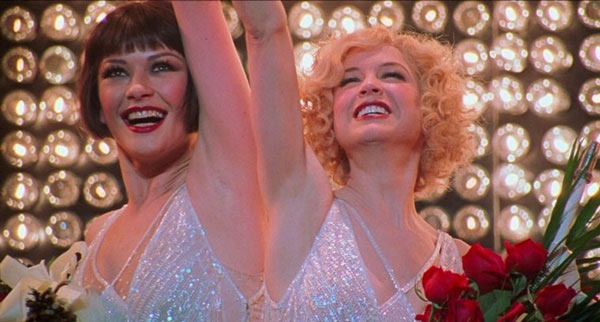
The movie Chicago is, as the title suggests, a work that is hard to separate from the city of Chicago itself.
It is not just a simple musical film; it can be seen as a masterpiece that showcases the history and culture of the city of Chicago, along with the atmosphere of that era on the screen.
Released in 2002, this film won six Academy Awards, including Best Picture, and became a major topic of discussion at the time.
The lead roles were played by Renée Zellweger, Catherine Zeta-Jones, and Richard Gere, with direction by Rob Marshall.
The original work is a Broadway musical from 1975, which remains famous enough to still be performed regularly.
The true charm of this film lies in its background.
Set in the 1920s, the so-called Jazz Age, Chicago during this time was a very unique period in American history.
Although Prohibition made alcohol illegal, it ironically allowed gangsters to thrive. A notable figure from this time is Al Capone.
At the same time, jazz clubs and vaudeville shows flourished, making Chicago a city where crime and entertainment intertwined.
The film sharply depicts this contradictory era. In particular, it satirically portrays the process by which criminals become stars through the combination of media, money, and power.
The structure where a murderer becomes a celebrity and is exonerated through the efforts of lawyers and media manipulation feels very realistic even today.
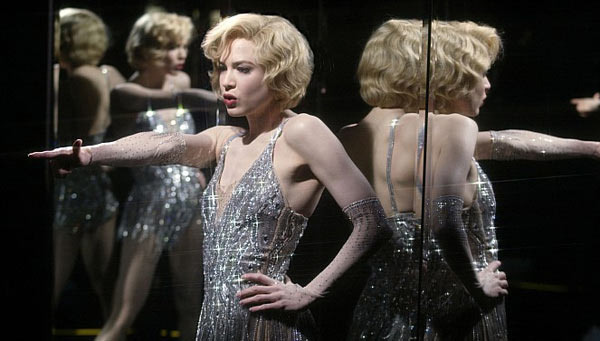
The presence of the two actresses is the core of this film.
Renée Zellweger's character, Roxie Hart, illustrates how an ordinary person with desires can dream of becoming a star.
Renée Zellweger, who plays Roxie Hart, is often perceived in America not as a typical "glamorous beauty" but as an actress with a realistic and approachable charm. Her physique is also known for not conforming to Hollywood's extreme thinness, as she is famous for naturally changing her weight according to her roles.
Because of this, she is strongly remembered as an actress representing "realistic beauty" and recognized for her acting skills among the American public.
In contrast, Catherine Zeta-Jones's character, Velma Kelly, is already a fully formed star on stage. The reason Catherine Zeta-Jones maintains short hair in the film Chicago is not just a style change but a choice that reflects her character's setting and the era's atmosphere. The Velma Kelly she portrays is a professional performer active on the vaudeville stage in the 1920s, characterized by strong charisma and an independent image.
During that time, the 'flapper' style was popular among women of the Jazz Age, and short bobbed hair symbolized freedom and rebellion, breaking away from the traditional image of women. Velma's hairstyle reflects this iconic aspect of the era. At the same time, her short hair emphasizes her sharp and calculating personality, as well as her strong presence on stage.
Additionally, from a choreography and performance perspective, short hair enhances the clarity of movement. Ultimately, this hairstyle can be seen as a very intentional setting that considers the character's personality, historical background, and stage direction.
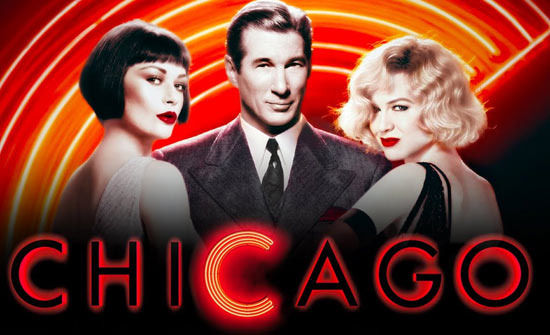
The contrast between these two characters creates tension throughout the film.
In particular, Catherine Zeta-Jones won the Academy Award for Best Supporting Actress for this role, and her performance remains impressively timeless. Her tap dancing, expressions, and charisma are all of very high quality.
The musical numbers cannot be overlooked. Songs like "All That Jazz," "Cell Block Tango," "Roxie," and "Mr. Cellophane" continue to be discussed even today.
These songs do not just have good melodies; they function as devices that convey both story and emotion simultaneously. In particular, the direction that intertwines reality and stage is a unique style of this film.
The box office success and market response are also significant. This film is regarded as a work that led to the revival of the musical film genre, recording high profits relative to its production costs. It marked a turning point for the musical film genre, which had been somewhat forgotten, and paved the way for several subsequent works.
One interesting question can be posed: how many films have the same title as the city they are set in? Surprisingly few.
While there are many films set in New York, there are limited cases where the title itself is the name of the city.
Examples like Chicago, where the city itself is presented as the title and its identity is woven throughout the work, are quite rare.
Thus, this film feels like more than just a backdrop; the city itself becomes a character.
Ultimately, this film is not just a musical. It showcases the desires, crimes, glamour, and human nature of the city of Chicago in the 1920s simultaneously.
One of the most iconic scenes in the film Chicago is the press conference scene featuring the lawyer Billy Flynn, played by Richard Gere.
This scene goes beyond simple musical direction and intuitively presents the core message the film aims to convey.
On the surface, it appears to be a press conference, but the direction flows completely differently. Billy Flynn is portrayed not as a real person but as a puppeteer controlling a puppet, while the surrounding reporters move like marionettes on strings.
The number that plays during this scene is "We Both Reached for the Gun," and both the lyrics and movements emphasize manipulation and control.
The meaning of this scene is clear. The media is not a vehicle for delivering truth but can become a tool that is manipulated by someone. Billy Flynn focuses not on the essence of the case but on how to package the story. In the process, even the reporters are reduced to mere roles of transcribing the message rather than being independent judges.
In particular, in this scene, Roxie Hart is depicted almost like a talking puppet. She does not tell her own story but speaks in the direction that Billy Flynn wants her to.
Ultimately, this puppet scene serves as a powerful metaphor visually demonstrating that "public opinion is manufactured." It is not just a flashy direction but can be seen as a scene that encapsulates the satire and message of the entire film.
Even though the film Chicago is set in the 1920s, the reason it resonates strongly with modern audiences is that the social structures and media environments it captures are fundamentally not very different from today.
While newspapers and radio were the key media for shaping public opinion at that time, today, social media and broadcasting have taken on that role. However, the way information is conveyed has changed, yet the fact that how events are reconstructed and consumed holds greater influence than the essence of the events remains the same. In particular, the media's role in narrating specific individuals and the public's reaction to that narrative can be seen as a pattern that transcends time.
In this context, this film is not just a period piece but a text that dissects the relationship between media and public psychology. Given that human attention, desires, and the power of media to amplify them have not changed, this work serves as a mirror reflecting both the past and the present.






 Day by day |
 Kitchen Ideas |
 Iowa Egen Aunt |
 Beauty, Health, Lifestyle Blog |
 Always Atlanta |
 Khan Film Blog Production |
 Illinois Mom |
 Rice Shop Uncle BLOG |
  Enjoyable American Life Diary |
 allstar realty |
  US Embassy |
  Korean Mom |
  My NYC |
  moo moo |
  Mr Oh |
  forevergee |
  festival |
  manchester |
  constant |
  Leapfrog Move |
  vibranto |
  Tora Tora |
  yellowbutter |
  Dolly |
  NYC saladbar |
  Finding Superfoods |
  lightyear |
  song bang |
  vexomo |
  Indiana Jones |