

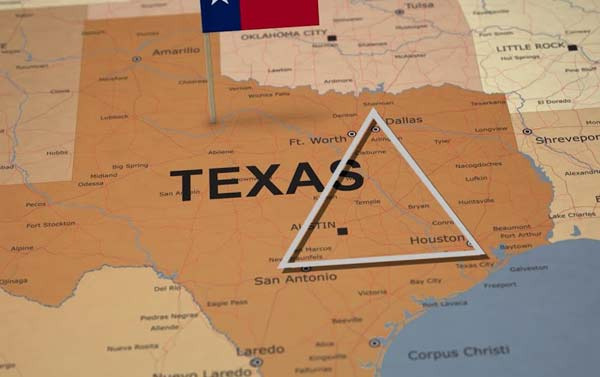
Have you heard of the Texas Triangle?
While the name might evoke an image of a triangular landform, in fact, this triangle refers to the area in Texas where the population is most densely concentrated. It is a massive metropolitan area shaped like a triangle, with Dallas-Fort Worth, Houston, Austin, and San Antonio as its vertices. This region serves as the center of Texas's economy, culture, and politics, with approximately 75% of the state's population (between 22 million and 23 million according to surveys) residing within this triangle.
This area is not just populous; it boasts significant economic power and plays a vital role as a hub in the southern United States. Historically, these regions have developed with diverse backgrounds and cultures. However, in modern times, they are closely interconnected, forming a vast economic zone.
First, let's look at the northern vertex, the Dallas-Fort Worth Metroplex. This area has grown into the largest center for finance and technology in the South. Once a hub for cotton trade and railroad transportation, it rapidly expanded into aviation, telecommunications, finance, and IT industries from the mid-20th century, and now it stands as the fourth largest metropolitan area in the United States. Dallas and Fort Worth each have distinct personalities; Dallas has a strong modern and international image, while Fort Worth better preserves the cowboy culture and traditions of the western frontier.
Next, the southeastern vertex, Houston, can be considered the heart of the energy industry in the United States. Houston rose to prominence as the center of the Texas oil boom following the discovery of the Spindletop oil field in the early 20th century. Today, it is home to the headquarters and major offices of giant energy companies like ExxonMobil, Shell, and Chevron. Additionally, Houston is a hub for the global medical industry, housing the Texas Medical Center, the largest medical complex in the world, and it is also significant in the space industry. The famous phrase "Houston, we have a problem" originated here due to the presence of NASA's Johnson Space Center in Houston.
The southwestern vertex, San Antonio, is a city of great historical importance. The Alamo, the site of a symbolic battle in the Texas War of Independence, took place here, and the Alamo fortress remains a historical site symbolizing Texas pride, attracting many tourists. San Antonio has a strong Hispanic cultural presence, being close to the Mexican border, which contributes to a high percentage of Spanish speakers. The River Walk, which flows gracefully through the city center, is a famous attraction, lined with various shops, restaurants, and hotels, beloved by both tourists and locals.
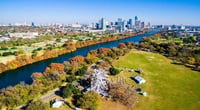
Finally, Austin, located in the middle, has become one of the most notable cities in recent years. Once known as a quiet state capital, it is now experiencing remarkable growth in the IT industry, earning the nickname 'Silicon Hills.' Global companies like Google, Apple, Tesla, and Meta have established large campuses or relocated their headquarters here. Austin is also famous as a city of music and culture. As the "Live Music Capital of the World," it hosts world-renowned music festivals such as South by Southwest (SXSW) and Austin City Limits every year. Politically, Austin is relatively progressive compared to the rest of Texas, showcasing a unique atmosphere distinct from the conservative nature of the state as a whole.
The highway network connecting these four cities is also a symbolic element of the Texas Triangle. Major highways like I-35, I-45, and I-10 tightly connect this region, facilitating active business and logistics movement. As a result, many companies choose this area as a logistics hub. In fact, it is considered one of the fastest-growing regions in the United States, with vibrant housing and employment markets.
The Texas Triangle is not merely a region with a few cities; it symbolizes how Texas, once reliant on agriculture and the oil industry, has balanced its development across advanced industries, healthcare, space, culture, and finance, becoming a pillar of the U.S. economy.
In the future, this triangle region will continue to be a crucial axis driving economic, social, and cultural trends in Texas and the entire United States. Population influx is steadily increasing, and various infrastructure investments are actively underway.
Therefore, many experts predict that within the next 20 years, this area will grow to become one of the most influential economic zones in the United States and a key growth hub and residential area to watch.






 ultron78 |
 garlic bread |
 Sugar Cream Door Bulletproof Noodles |
 urbanmint |
 |
| 
 |
| 
 U.S. Weather Bureau News |
  Living with a Consistent Heart |
 quanta7 |
 Dallas Fort Worth DFW |
  Korean Mom |
  My NYC |
  moo moo |
  Mr Oh |
  forevergee |
  festival |
  manchester |
  constant |
  Leapfrog Move |
  vibranto |
  Tora Tora |
  yellowbutter |
  Dolly |
  US Embassy |
  NYC saladbar |
  Finding Superfoods |
  lightyear |
  song bang |
  vexomo |
  Indiana Jones |