
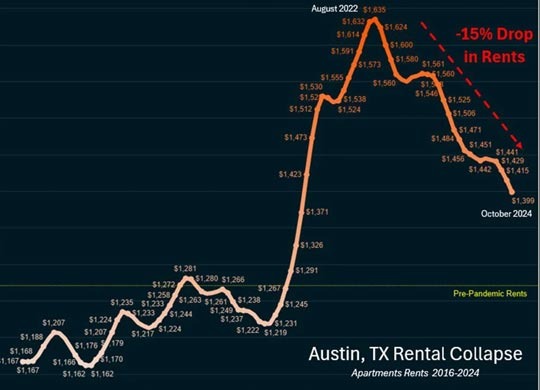
These days, the atmosphere in the Austin real estate market has definitely changed a lot. The housing market in Austin, which was once so hot that people said, 'This is a bubble,' has noticeably cooled down now. Since peaking in mid-2022, home prices have dropped by more than 20%.
The drop in rental prices has also been quite significant. Recent statistics show that as of September 2025, prices have fallen by about 15% compared to the previous year.
As prices have decreased, the market has naturally shifted to a 'buyer's market.' For those looking to buy a home, this is a much more favorable time than before. There are many listings, and competition is less intense.
In 2021, it was common for more than 10 people to make offers simultaneously for a single home, but now that frenzy has almost disappeared. Instead, the number of listings on the market has increased, providing more options, and buyers have gained more leverage at the negotiation table.
Of course, it is still hard to say that home prices in Austin are cheap. When looking at the U.S. as a whole, the median home price in Austin is still relatively high. This is because the city's underlying economy is very solid. Major companies like Tesla, Google, and Apple are expanding their campuses in Austin, leading to continuous job growth and a steady influx of population. These structural factors help prevent the market from completely collapsing due to short-term economic fluctuations.
In the long term, the Austin market is likely to show a recovery trend after going through a 'correction period.' This city remains one of the fastest-growing cities in the U.S., especially driven by the technology industry. The influx of IT startups, semiconductor companies, and engineering talent continues to support local real estate demand. Therefore, experts predict that "Austin will rebound after this cooling period."
So, what does this market mean for buyers now? First of all, there is a wide range of choices. In the past, there were hardly any homes that fit the budget, but now it is possible to compare various options in terms of location, size, and conditions. Additionally, buyers can position themselves favorably in negotiations. Sellers can no longer insist on high prices as they did before. It is now a time when slight price adjustments or negotiations on repair conditions are possible.
On the other hand, it is a time that requires patience for sellers. The era of 'contract completed as soon as listed' is over. Now, the time listings stay on the market has increased, and competition has become fierce. Therefore, if you want to sell, having price competitiveness is the most important thing. Even setting the price slightly above the surrounding market can lead to long periods without a sale. Realistic pricing and consistent marketing strategies are needed at this time.
Ultimately, the Austin real estate market can be seen as entering a 'calm equilibrium.' The market, which overheated after the pandemic, is undergoing a natural adjustment and returning to a healthy state. In the short term, the downward trend in prices may continue, but considering the city's economic foundation and population influx, the long-term outlook remains positive.
For those looking to buy a home, it is a time of opportunity, and for those looking to sell, it is a time that requires strategy. The Austin real estate market is now at a point where realistic judgments are more important than ever.
 USAToday








 moo moo |
 ultron78 |
 garlic bread |
 Sugar Cream Door Bulletproof Noodles |
 urbanmint |
 Living with a Consistent Heart |
 quanta7 |
 |
| 
 U.S. Weather Bureau News |
 History Repeats Itself |
  Tonky |
  viroma |
  cookie |
  Live and that's it |
  Alright Twain |
  eatontown blog |
  HAWAII Korean Church News |
  Amore |
  linex |
  Balancework |
  laro90 |
  MEDBIO American Doctor Blog |
  SWAT TEAM BLK |
  DREAM BIG |
  frostbite |
  330 Forever My Love |
  El Dorado |
  dralix58 |
  Gorama Round |
  Skydiving |