

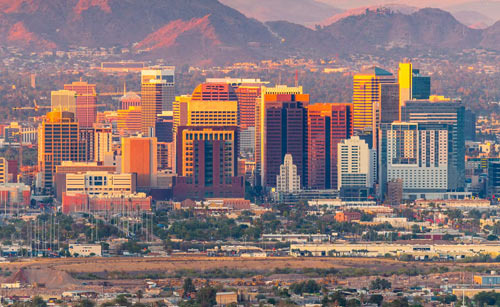
Many people are often surprised when they first encounter the Phoenix economy.
While it's easy to think of a city in the middle of the desert as being centered around tourism or retirees, it is actually one of the fastest-growing metropolitan economies in the United States. The population is increasing rapidly, and businesses are consistently relocating, making the Phoenix metro area a new growth engine in the western U.S.
Above all, the semiconductor industry is a crucial topic when discussing the Phoenix economy. TSMC, the world's largest foundry company, has garnered national attention by building a cutting-edge semiconductor factory worth billions of dollars in northern Phoenix. The first plant has already begun production, and additional factory construction is underway. Intel also operates a large manufacturing facility in Chandler, making Arizona a key hub for the U.S. semiconductor industry. A variety of jobs are increasing, from high-tech positions to construction, logistics, equipment maintenance, and parts suppliers.
The finance and insurance sectors are also significant pillars of the Phoenix economy. Major companies like American Express, Bank of America, and Charles Schwab have large operational centers here. The relatively lower cost structure compared to California, along with ample office space and ease of workforce acquisition, are factors attracting businesses. In fact, there are ongoing cases of companies from the western region relocating some departments to Phoenix to cut costs.
The tourism industry also plays an important role in the Phoenix economy. Especially in winter, numerous tourists and retirees from the northern U.S. and Canada visit. High-end resorts and golf courses in Scottsdale are considered key revenue sources for Arizona's tourism industry. Annual golf tournaments and Major League Baseball spring training also generate significant spending in the local economy.
The healthcare industry is also growing rapidly. World-class medical institutions like Mayo Clinic and Barrow Neurological Institute are located here, leading to a steady increase in jobs in healthcare services and the biotech sector.
However, there are downsides to this growth. The biggest issue is the rising housing prices. Once known as an affordable city, Phoenix has recorded some of the highest home price increases in the nation in recent years. As the population continues to grow, the burden of rent and housing prices is also increasing.
Traffic congestion has also worsened compared to the past. Phoenix is a car-centric city, and as the population grows faster than road expansion, more areas are experiencing longer commute times.
Above all, many experts are focusing on the issue of water. As a desert city, securing water resources is crucial. With the prolonged decline in the Colorado River's water levels, discussions continue about whether the city can sustain ongoing population growth and development.
Ultimately, Phoenix is currently one of the most dynamically growing economic regions in the U.S. The semiconductor, finance, healthcare, and tourism industries are all growing simultaneously, with businesses and populations steadily moving in. However, how the city addresses the challenges of rising living costs and water shortages will be a critical factor in determining Phoenix's future. It can be seen as a city where sustainability is being tested alongside the pace of economic growth.
 CrystalRiver98
 LunaStar



 My Town My Way Blog |
 celion78 |
 Only Dentalbay |
 Snack-like Blog Writing |
 Yo Lock Me Up |
 business lim |
 Toaster Pizza Magic Show |


 My Love DS |
  Leapfrog Move |
  US Regional Information Local News |
  Finding Superfoods |
  COLO COLO |
  morixa |
  nero kim |
  USA Hyundai Kia |
  OC Real Estate Business Information |
  Splendid Mission |
  Yonori Nori |
  Unknown Dog Walk blog |
  Dingho and USA News |
  Enjoyable American Life Diary |
  Nevada Vegas UNLV |
  Sammy Beach |
  Nanana Nanana Nanana |
  Sunny's Travel in America |