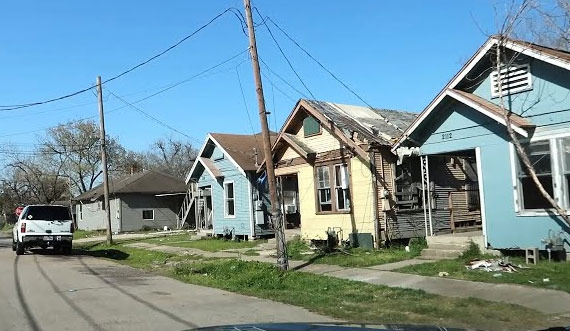
Although the terms ghetto and hood used to refer to impoverished areas in Houston may seem similar, the feelings they evoke are subtly different.
In American English, the term ghetto commonly brings to mind structural issues within a community.
The word ghetto, referring to a poor neighborhood, originally meant an area designated for Jews to live in medieval Venice.
During World War II, the ghettos created by Nazi Germany forcibly relocated Jews from their homes into cramped and poor areas, which became infamously known in war history.
For example, the Warsaw Ghetto was surrounded by walls and barbed wire, with strict control over external access, and limited supplies of food and medicine led many to die from starvation and disease. Over time, the term expanded to mean 'a neighborhood where a minority group lives' and took on a completely new character when it crossed over to America. In the U.S., it has solidified as a term referring specifically to neighborhoods predominantly occupied by African Americans, immigrants, and low-income residents.
During the industrial era, it had the nuance of "a neighborhood where opportunities are scarce and poverty has settled," and in the 80s and 90s, influenced by hip-hop culture and films, it gained the symbolism of "a rough area with strong survival instincts." Thus, nowadays, when people hear ghetto, they perceive it not just as a poor area but as a very American expression intertwined with history, culture, and social realities.
So when someone refers to an area as a ghetto, it naturally implies more than just danger; it suggests "a zone where poverty and crime are entrenched."
On the other hand, hood is a term that feels closer to everyday life. Derived from neighborhood, it carries a rough yet human aspect. This term has spread widely with hip-hop culture, incorporating elements of self-deprecation, humor, and identity, with some saying, "I grew up in the hood" as a form of pride.
Thus, while hood can be dangerous, it also has a friendly element of 'our neighborhood.' Ultimately, ghetto is a term heavily laden with urban issues, while hood is a younger, street-savvy expression, and Houstonians use both words differently depending on the context.
Now, speaking of the Houston area, this city has many affluent neighborhoods but also has a wide spread of vulnerable areas referred to as ghettos or hoods. In fact, neighborhoods like River Oaks, Memorial, West University, and Bellaire are densely populated with high earners and professionals, and housing prices are very high. These areas, lined with upscale restaurants, shopping centers, and well-maintained residential areas, are undeniably stable and wealthy neighborhoods.
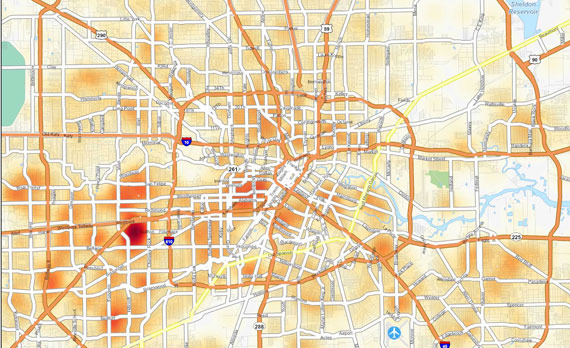
However, just a few blocks away from Houston's affluent areas, the atmosphere can change dramatically. Houston has long been known as a city with a stark income gap, and certain ZIP codes have recorded the highest crime rates in the nation.
Given that Harris County is large and populous, a natural structure has formed where neighborhoods with high safety levels mix with those that do not. Areas like 5th Ward, 3rd Ward, Sunnyside, and Gulfton traditionally have high proportions of low-income residents, with old apartments and poorly maintained houses clustered together.
These areas, lacking economic opportunities and relatively less infrastructure investment, have long been perceived as places with high crime and poverty rates. Of course, over time, some areas have undergone remodeling and redevelopment, significantly changing the atmosphere, but there remains a noticeable difference that makes one feel, 'Wow, Houston really has such contrasts.'
Interestingly, these regional differences are not simply divided by urban and suburban lines. Houston is a city with almost no formal zoning regulations, so commercial and residential areas are mixed, and it is common to see affordable apartments next to upscale townhouses.
Therefore, newcomers often check whether 'Is it safe here?' or 'Can I walk around at night?' for each neighborhood. It is common to find one side of the street lined with modern luxury apartments while the opposite side has old residential areas and abandoned construction sites.
Because of these contrasts, Houstonians often mention ZIP codes or specific street names when discussing certain areas. As the city grows rapidly, it continues to change.
With countless immigrants and young professionals flocking in and new developments continuing, even areas once deemed dangerous are gradually changing their atmosphere. However, there still exists a significant gap in income and environment throughout the city, and this contrast seems to have become one of the defining characteristics of Houston.
#houston
#neighborhoods
#ghetto
#hood
#wealth
#poverty
#crime
#culture
#urban
#texas









 moo moo |
 ultron78 |
 garlic bread |
 Sugar Cream Door Bulletproof Noodles |
 urbanmint |
 U.S. Weather Bureau News |
 Things to know |
 Premium Gas Camp |
  Texas Real Estate Blog |
 action blog 101 |
  US Embassy |
  Korean Mom |
  My NYC |
  Mr Oh |
  forevergee |
  festival |
  manchester |
  constant |
  Leapfrog Move |
  vibranto |
  Tora Tora |
  yellowbutter |
  Dolly |
  NYC saladbar |
  Finding Superfoods |
  lightyear |
  song bang |
  vexomo |
  Indiana Jones |