

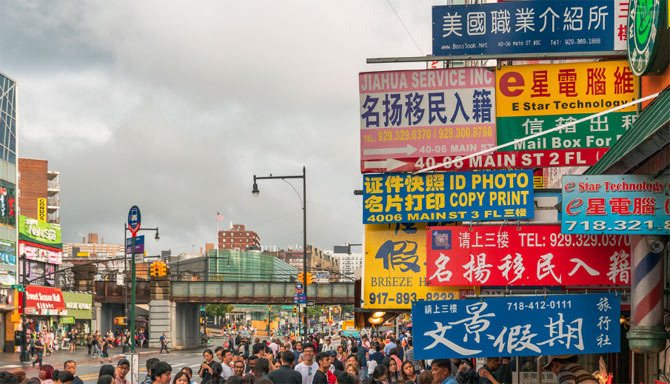
When talking about the Flushing commercial area, the most common remark these days is that there are too many Chinese shops.
If you actually walk down Flushing Main Street, you can immediately feel that everything from the signs to the atmosphere has completely changed from before. In the past, Flushing had a strong image as a Korean-centered commercial area. There were banks, hospitals, real estate offices, restaurants, and academies where life could be conducted in Korean, and while there were certainly Chinese shops, they did not have the overwhelming presence they do now.
In the past, there was a time when Hong Kong Chinese and Koreans coexisted with many shops as neighbors, maintaining a certain balance.
Today's Flushing is definitely different. Not only has the number of Chinese shops increased, but their nature has changed as well. While there were many family-run stores operated by the first generation of immigrants in the past, nowadays, there is a noticeable increase in corporate Chinese shops with substantial capital.
They are quite large in scale, well-decorated with a sense of uniformity, and it is common for one business to operate multiple locations simultaneously. Even in restaurants, there are not just simple neighborhood Chinese eateries, but places that specialize in specific regional cuisines, and price competition has become much fiercer.
The biggest difference from the past is the turnover rate. The Flushing commercial area used to operate relatively slowly. It was focused on regular customers, and weekend sales were important. Now, the flow of people has changed. Visitors from mainland China, short-term residents, and customers coming from other boroughs combine to create a constant stream of people throughout the day. The increasing number of shops that stay open late into the night is also a clear departure from the past.
This change is also reflected in rental prices. As the number of Chinese shops has increased, the value of the commercial area has risen, resulting in a significant jump in rental prices. It has become common to see amounts that far exceed what Korean small business owners used to manage.
Naturally, shops with weaker capital have been pushed out, and Chinese shops have filled that space. In this process, the center of the Korean commercial area has gradually moved from Flushing Main to the outskirts. The reasons for moving towards Northern Boulevard, Murray Hill, and Bayside are found here.
Another change is the language. In the past, Korean and English were the main languages, but now Chinese feels like the primary language of the commercial area. Menus, advertising flyers, and signs are primarily in Chinese, with English often serving as a secondary language. While this may feel unfamiliar to Koreans, it also reflects the reality of Flushing.
Personally, I feel that the changes in Flushing are more about a shift in dominance rather than the rise and fall of the commercial area. It was once a stage for the growth of Korean immigrants, and now it has become an expansion space for Chinese immigrants.
Today's Flushing is busier and more vibrant, but at the same time, the emotional familiarity of the past has faded significantly. Rather than being good or bad, I think it reflects how the city of New York is undergoing another transformation.



 ultron78 |
 garlic bread |
 Sugar Cream Door Bulletproof Noodles |
 urbanmint |
 |
| 
 nova nova |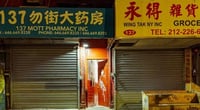
 TwinBee |
 Living in the Eastern United States |
 Whisper |
 MintO |
  Korean Mom |
  My NYC |
  moo moo |
  Mr Oh |
  forevergee |
  festival |
  manchester |
  constant |
  Leapfrog Move |
  vibranto |
  Tora Tora |
  yellowbutter |
  Dolly |
  US Embassy |
  NYC saladbar |
  Finding Superfoods |
  lightyear |
  song bang |
  vexomo |
  Indiana Jones |