

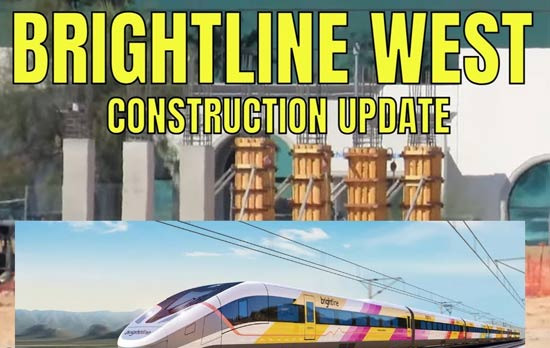
The high-speed rail Brightline West, connecting Los Angeles and Las Vegas, is in the news due to cost issues.
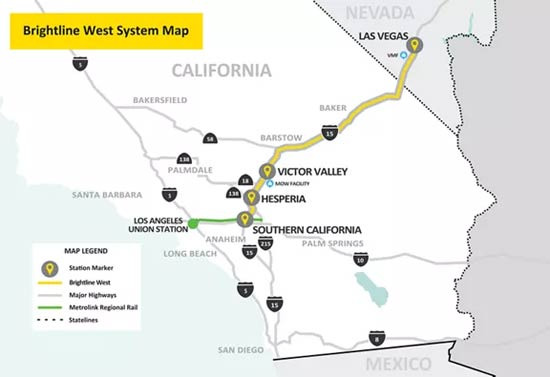
The project was planned to start near Rancho Cucamonga, an hour's drive east of LA, and connect through Victor Valley and Apple Valley to near the Las Vegas Strip. However, there are now plans to extend the section from downtown LA to Victorville separately, with the first phase, the Victorville-Las Vegas line, expected to be completed first.
This section is characterized by installing tracks along the median of the existing I-15 highway, minimizing land compensation issues. It aims for a top speed of about 200 miles per hour, receiving expectations as 'America's first true high-speed passenger rail.'
Originally, it was supposed to be completed by the summer of 2028, before the Olympics, but it has now been pushed back to the end of 2029. In the meantime, costs have skyrocketed from an initial estimate of about $8 billion to now $21.5 billion. The construction costs have nearly tripled compared to the initial estimates.
The reason for the soaring costs is the skyrocketing prices of construction materials and the difficulty in finding skilled labor. Moreover, with the surge in data centers and various renewable energy projects driven by the AI boom, the demand for electrical equipment and construction machinery has surged, causing high-speed rail construction costs to rise dramatically.
Currently, Brightline West is trying to secure a $6 billion loan from the U.S. government to continue this project, and if this is not approved, the entire project could come to a halt. This is bad news for developers and local residents who were hoping for rising property values from Rancho to Victorville and Hesperia.
The already issued $2.5 billion in municipal bonds have also dropped in price, shaking investor confidence, and there are concerns that if this loan is not finalized by November, early repayment obligations may arise. This could potentially collapse the entire funding structure of the project.
What's more concerning is that the high-speed rail project the company operates in Florida is already operating at a loss.
It reportedly lost over $500 million in 2024 alone, leading investors to question, "Isn't the Las Vegas line going down the same path?" As this anxiety grows, the value of the bonds issued by the company has reportedly dropped to around 75 cents per dollar.
However, it has not completely stopped. In fact, construction of the station site near the Las Vegas Strip has already begun, and soil surveys and design work for the Victorville and Apple Valley sections are nearly complete.
At the construction site, equipment is moving around, and a temporary office has been set up in the middle of the desert. However, the actual installation of structures can only proceed once funding is secured, so they are still waiting.
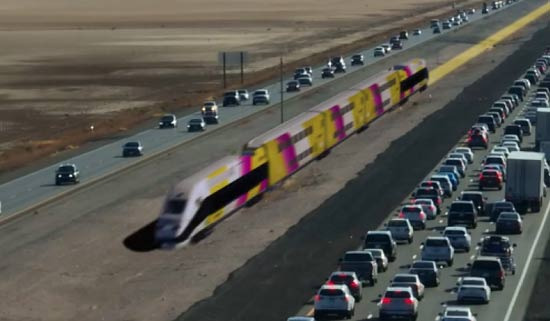
Public opinion is divided. Some cynically view it as "just another unfinished infrastructure project," while others still support the idea that "someone has to start for the high-speed rail era to begin."
In reality, millions of people travel between Los Angeles and Las Vegas each year, and considering the traffic jams on I-15 every weekend, the demand itself is sufficient. The U.S. has a tight airline schedule, resulting in fewer train passengers, so there is a significant opinion that the U.S. should open the high-speed rail era during this opportunity.
If this project, which has become uncertain, succeeds, it will fundamentally change the travel culture in the western United States. A time will truly come when one can leave LA in the morning, enjoy brunch in Las Vegas by noon, and return home by evening. The question is when that day will come and whether they can hold out until then. Moreover, the Las Vegas tourism industry is currently shrinking, so the outlook for demand on the route from LA to Las Vegas is not bright either.
Ultimately, the fate of Brightline West will be decided by the end of the year. If the government loan is approved, new opportunities will open up, but if not, the project itself could be shaken.
This challenge to change the U.S. transportation culture, which has been centered on cars and airplanes, is precarious, but we still hope for the day when the first high-speed train will run, overcoming adversity.






 ultron78 |
 garlic bread |
 Sugar Cream Door Bulletproof Noodles |
 urbanmint |
 |
| 
 Star Way |
 CA Real Estate |
 some fame |
 Choi Cho |
 manchester |
  constant |
  Leapfrog Move |
  vibranto |
  Tora Tora |
  yellowbutter |
  Dolly |
  US Embassy |
  NYC saladbar |
  Finding Superfoods |
  lightyear |
  song bang |
  vexomo |
  Indiana Jones |
  meloncat |
  novapixel |
  mortrix |
  Esther 1983 |
  fortbliss |
  Moscow Kim |