

When you first hear the term magic square, it's easy to think of it as just a number puzzle.
However, it's not just a simple game. In English, it's called a magic square, which literally means "mysterious square."
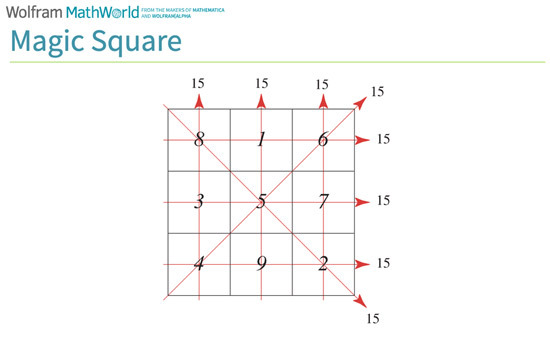
The structure involves placing the numbers from 1 to n² into an n×n square grid, ensuring that the sums of the rows, columns, and diagonals are all the same.
This common sum is referred to as the magic sum.
The most basic form is the 3×3 magic square. The goal is to fill it with the numbers from 1 to 9 so that the sum in all directions equals 15.
Interestingly, it doesn't just happen randomly. The center must contain the number 5 to maintain balance.
Additionally, the other numbers must follow a specific pattern. At first glance, it may seem random, but in reality, it converges to a single structure.
Excluding rotations or reflections, it's the same pattern. When you try it, you might wonder, "Why isn't this working?" But once you understand the structure, the solution suddenly becomes clear.
From here, it can expand into larger magic squares like 4×4 or 5×5.
The problem is that as the size increases, the difficulty rises sharply.
In particular, odd-sized magic squares have relatively systematic methods for filling them step by step.
There's a consistent algorithm where you move up, shift sideways, and if blocked, come down.
However, even-sized magic squares are a different story. They cannot be solved with a simple rule.
They involve complex methods like exchanges, inversions, and symmetries. Thus, they become quite an interesting topic mathematically.
I believe the reason magic squares attract people is that they resemble a game of balance. The fun of making you think continuously is addictive.
The numbers aren't just scattered randomly; they produce the same result in all directions.
This isn't just simple calculation; it's a form of order. Therefore, in ancient times, it wasn't seen as just a puzzle.
It was viewed as a tool symbolizing the harmony or balance of the universe.
In particular, the legendary magic square from Chinese folklore is said to have originated from patterns found on a turtle's back.
Regardless of whether this is true or not, it's clear how mysteriously people viewed this structure.
In modern times, it's more like a brain game. You'll realize if you try it yourself that it's not as easy as it seems. If you place one number incorrectly, the entire balance collapses.
You have to erase it and start over. This process naturally requires concentration and pattern recognition skills.
That's why it's often used for educational purposes. Especially for children, it's a pretty good tool for "practicing logical thinking."
It doesn't just involve matching numbers; it encourages seeing the overall structure.
Magic squares are not just a simple sensation; they are structured with formulas. In an n×n magic square, the sum of each row is always constant.
This is called the magic constant, calculated as n(n²+1)/2.
This formula signifies that it's not a puzzle solved by intuition, but rather a mathematically complete system.
It's not about placing numbers randomly; it's a structure that moves within a predetermined framework.
Ultimately, a magic square appears to be a simple number game on the surface, but upon closer inspection, it reveals a structure intricately woven with rules, balance, and patterns.
At first, it starts as just a time-filling puzzle. But once you dig a little deeper, the feeling changes.
The question "Why does this work?" continues to follow you. And as you solve that question, you naturally transition into mathematical thinking.
That's why magic squares are deep enough to be considered difficult, yet light enough to be approachable.
I believe that's why people in the past were captivated by them, and why they still hold interest today.







 Giant Squid and Sweet Potato Soup |
 Lol Life |
 lavender |
 logger |
 Conflite Teacher |
 Western US Medical Student Association |
 DOCTOR MED |

 Koreab Date |
 good thinking |
  Idaho's Sumi's House |
  Mr. Midwest America |
  wildfire |
  kerkee |
  legalway |
  postcard |
  cheesecake07 |
  My Miami Stories |
  windylotus |
  Mia Flori |
  velaro29 |
  velaro |
  foxtrot83 |
  moname |
  mapleline |
  US Legal Consultation on Trials |
  UNI Lover |
  Karina's Blog |
  California Dreamer |
  Choco Mint Creator |