

Have you heard of the Pareto Principle, which is circulating among self-development enthusiasts in the U.S. these days?
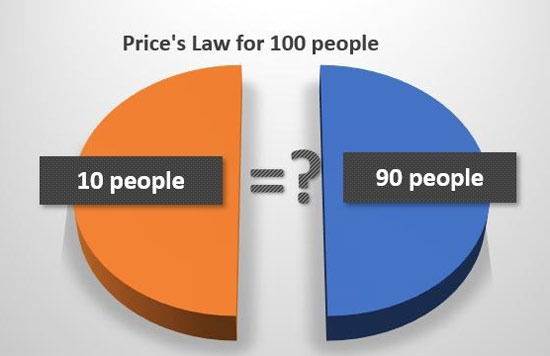
In summary, this principle states, "In any field, only the square root of the total number of people produces half the results."
In simpler terms, in a company of 100 people, about 10 are the ones actually driving results, and in an industry with 10,000 competitors, around 100 ultimately hold the market's core.
If you think about it, it's really true. In a department with ten people, there are usually only one or two who are genuinely working, while the rest are just there.
People come into meetings, nodding and saying, "Hmm," and "Right," before leaving. This is true for both Korean and American companies.
And when those one or two people are absent, the department just collapses, making you realize that this principle is indeed correct.
The story about Spotify is also amusing. They say there are 11 million artists there.
But only 3,300 of them take half of the total streaming revenue. That's 0.03%. The remaining 10,996,700 are just people who have their music out there saying, "Please listen to my song."
Honestly, isn't that a bit harsh? Every time we open Spotify, we're just making those 3,300 people richer. A penny goes into Taylor Swift's account every time.
But this isn't just about music. Out of 30 million businesses in the U.S., 5,500 create half of the economic output.
These include companies like Amazon, Apple, and Microsoft. We use them every day.
Our phones are Apple, our cloud services are Amazon, and our company emails are Microsoft. Ultimately, all the money we spend flows into those 5,500 companies.
Living in the U.S., you really feel that a few big tech companies consume everything.
No matter how hard a small business owner in Koreatown works, they can't compete with the massive system above them.
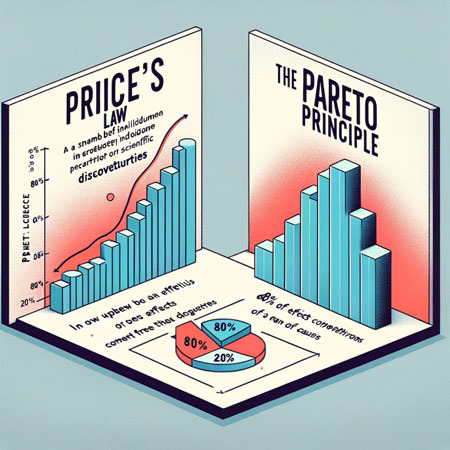
And the author of this article shares another interesting thought. "Competence increases linearly, while incompetence increases exponentially."
At first, I wondered what that meant, but after thinking it over, it makes perfect sense. Truly capable people grow slowly.
But what about incompetent people? Once they start to fail, they just spiral out of control.
Interestingly, the more skilled someone is, the more they say, "I'm really not that great; I was just lucky," while those who struggle often think, "I'm working hard, so why isn't it working?"
When you see Korean friends who are doing well in the U.S., they are all humble. They say, "It just happened that way."
But those who don't realize what they're doing wrong always believe they are the hardest workers. They confuse activity with results.
So this article also talks about time. If you work 40 hours a week, only about 6 hours are truly important.
The remaining 34 hours are just maintenance, emails, and killing time.
Honestly, anyone who has worked in a company would agree. The time spent actually thinking is probably just one or two hours a day.
The rest is spent checking Slack, organizing calendars, and attending "team sync meetings" while folding laundry with the camera off.
But in trying to fill those 34 hours, we often neglect the 6 hours that matter. It's funny, isn't it?
And there's a crucial saying: "You can't know which 10 out of 100 will succeed without creating all 100." This is truly a truth.
When people in the U.S. try to do something, if it doesn't work out a few times, they just give up.
They write three blogs and say, "Oh, this isn't working," or upload five YouTube videos and say, "The views aren't coming," and then quit.
But statistically, that's just how it is. Expecting to succeed with five uploads is unrealistic.
You need to create 100 to discover the real ones among them, yet we always give up too quickly. I do too.
But to be honest, knowing this principle has also made me feel a bit more at ease.
Because it makes me realize that not everyone can excel, and accepting that is important.
Ultimately, the message of this article is this: 90% of effort may seem like wasted effort, but without that 90%, the remaining 10% won't come either. So just throw yourself into it.
Create results that may seem terrible, attend meetings that seem pointless, and meet people who seem irrelevant. You won't know what's real until much later.
It feels a bit nihilistic, but when you think about it, that's life. For us Koreans living in the U.S., it's the same.
At first, we don't know what the right path is, so we try everything. We try running a Korean restaurant, a laundromat, real estate, and sending our kids to tutoring.
Then at some point, we realize, "Ah, this is my path."
It's a harsh principle, but in a way, it's hopeful. After all, you just need to be part of the square root.
 Amulius
 MacaronJoy
 MacaronFox
 TexasMan







 Victory 1988 |
 Infinite Style |
 novapixel |
 zephyrs |
 Arizona Cowboy |
 Western US Medical Student Association |
 Time is GOLD |
 DOCTOR MED |
 good thinking |
 Sams Market |
  ansdal |
  VVV 80 |
  BIODOCTOR NEWS |
  Gold Bar |
  Tamfa Fan |
  Jenny's Mom blog |
  Karina's Blog |
  Best Frozen Yogurt |
  Coding Elf |
  Mr Cleveland |
  Sugar Cream Door Bulletproof Noodles |
  lavender |
  macan 08 |
  Goroke Geureoke News |
  colo colo |
  U.S. Weather Bureau News |