

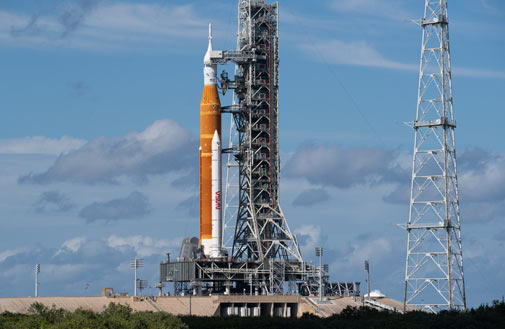
News has emerged that NASA has acknowledged the issues with the SLS (Space Launch System), which has been both a point of pride and a headache for the agency.
To discuss the SLS rocket, we need to go back to the spring of 2022. NASA attempted to roll out the world's largest and most expensive orange rocket to the pad for a fueling exercise, but it failed not once, not twice, but three times in a row. Hydrogen leaked, and leaked again, and leaked once more. On the fourth attempt, they nearly ignited the rocket, but it was ultimately halted again.
At that point, the mood shifted to "let's just launch it already," and the fifth practice, which was essentially the first launch attempt, also failed. The sixth attempt failed as well. Finally, on the seventh try, it took to the skies. That day was November 16, 2022. It flew beautifully, but the process was fraught with issues.
After a successful launch, one would expect the problems to be resolved, but in January of this year, NASA set the new rocket back on the pad for a fueling test for the crewed Artemis II mission orbiting the Moon, and surprisingly, hydrogen leaked again.
This leak occurred in almost the same location as three years prior. After hours of struggle, they managed to fill the tank, but just before the countdown ended, the leak rate surged again, leading to an automatic hold at T-5 minutes. As a result, the February launch was postponed, and it was pushed back to at least March.
During a press conference, questions arose about why the issues from three years ago had not yet been resolved. NASA explained that hydrogen is a very small molecule, making it difficult to handle, and there are limitations to the tests that can be conducted on the ground.
However, looking deeper into the situation is disheartening. The rocket is so expensive that there is no budget for a separate test tank. Each launch costs over $2 billion, and the launch pad itself is worth $1 billion. It is not designed to frequently fill the tank and risk potential damage. As a result, every attempt becomes a real-world experiment.
This time, the atmosphere changed due to a comment from the new administrator, Jared Isaacman.
He publicly noted that the frequency of test flights for the SLS is the lowest among NASA rockets.
In fact, this has been known in the industry for a long time. A rocket that is too expensive to launch frequently is inherently risky. Until now, this fact had not been officially stated.
Within NASA, there is now an acknowledgment of this reality. A rocket that launches once every three years is essentially an experiment each time, and each launch is described as a handcrafted 'work of art.' While this is a nice expression, it also means that each launch is a high-priced prototype that needs to be tamed anew.
Meanwhile, in the private sector, SpaceX's Starship and Blue Origin's New Glenn are evolving at a much faster pace. The nickname "Slow Launch System" for NASA did not come about for no reason.
Ultimately, the SLS is an art-like rocket, and each launch is an adventure. While that in itself is romantic, considering the schedule, budget, and reality, it is far from an ideal system. I believe it is significant news that NASA has only now publicly acknowledged this fact.







 Moscow Kim |
 coloradoman |
 Montgomery Mom |
 GOGO SING |
 Hajiwon Blog Hair Salon |
 Illinois Mom |
 Rice Shop Uncle BLOG |
 Khan Film Blog Production |
 Nanana Nanana Nanana |
 Enjoyable American Life Diary |
  forevergee |
  festival |
  manchester |
  constant |
  Leapfrog Move |
  vibranto |
  Tora Tora |
  yellowbutter |
  Dolly |
  US Embassy |
  NYC saladbar |
  Finding Superfoods |
  lightyear |
  song bang |
  vexomo |
  Indiana Jones |
  meloncat |
  novapixel |
  mortrix |
  Esther 1983 |