

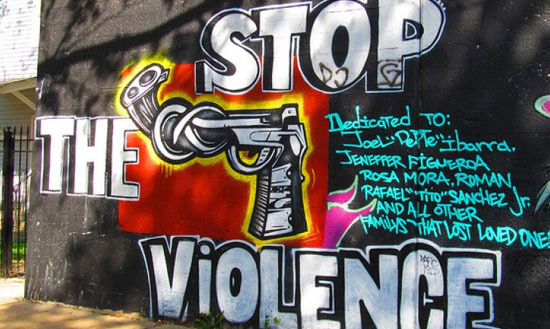
Since the Trump administration, stories about gang arrests in Chicago have often been tied to political discussions.
So it's not that "gangs in the Chicago area have disappeared after the Trump administration," but rather that the methods of enforcement have changed, leading to different arrest patterns than before.
The Trump administration embraced crime issues quite politically from the outset. In particular, regarding urban crime, they repeatedly stated that "loose law enforcement has led to these issues," and Chicago was frequently mentioned in this context.
In this atmosphere, gang enforcement in Chicago has shifted from being handled by local police to a structure where federal agencies take the lead. Federal investigative agencies like the FBI and ATF have become actively involved, and the approach of treating gun crimes and drug crimes together as organized crime has been strengthened.
Whereas previously, each incident of someone being shot on the street was pursued individually, during this period, the direction has shifted to cutting off the problem from the top down. They dug into who bought the guns, where those guns came from, and how the money was circulating.
As a result, there were specific periods when the number of arrests spiked significantly. There were many cases where gang members involved in illegal gun possession, violations of federal gun laws, and drug distribution were charged all at once. Importantly, those arrested were not just low-level members. Individuals who played roles in managing people and handling money were also included.
The Trump administration promoted this as a "result of strong law enforcement," and there were evaluations from conservative circles that it was indeed effective. However, the experiences of people living on the ground tell a different story. Gangs do not simply disappear after a major crackdown. When one organization collapses, another group fills the void, leading to further conflicts, and this pattern repeats.
Thus, while news of large-scale arrests continues to emerge, many people do not feel that the gunfire in their neighborhoods has noticeably decreased.
Another contentious issue has been the tension arising from the mixing of these crackdowns with immigration enforcement. With the federal government taking a strong stance, there were complaints that even communities unrelated to actual crime felt intimidated. There were statements like, "It seems they view the entire neighborhood as potential criminals, not just the gangs."
Nevertheless, many evaluations agree that the nature of gang arrests in Chicago has changed since the Trump administration. The focus has shifted from local police to large-scale operations led by federal authorities, and there has been an increase in structural investigations that link guns and drugs together.
So now, whenever discussions about Chicago's public safety arise, opinions seem to be divided based on this period, with evaluations varying between positive and negative.






 US Embassy |
 fortbliss |
 Folding Instructions |
 yentra |
 Cali M Law Group |
 Khan Film Blog Production |
 Illinois Mom |
 Rice Shop Uncle BLOG |
 Enjoyable American Life Diary |
 allstar realty |
  Korean Mom |
  My NYC |
  moo moo |
  Mr Oh |
  forevergee |
  festival |
  manchester |
  constant |
  Leapfrog Move |
  vibranto |
  Tora Tora |
  yellowbutter |
  Dolly |
  NYC saladbar |
  Finding Superfoods |
  lightyear |
  song bang |
  vexomo |
  Indiana Jones |