

In the late 1980s, when I began studying engineering as a college student in the United States, the universe was just a story in textbooks.
It was a realm of imagination in movies, accessible only to the vast organization of NASA with its enormous budget.
Now, in my 50s, I feel a strange thrill watching the private company SpaceX repeatedly "explode" in its efforts to send humans to Mars.
Starship. The name itself is romantic. This spacecraft, led by Elon Musk's SpaceX, is not just a simple rocket.
It is a grand design aimed at turning the absurd dream of human migration to Mars into reality. It is a reusable system designed to be about 120 meters long, capable of launching from Earth, landing on Mars, and returning to Earth. Literally, a 'round trip' spacecraft to Mars.
The recent 9th test flight has once again become a hot topic. Some media reported it simply as "it exploded," and there were frequent comments online asking, "Is it another failure?"
However, from an engineer's perspective, this is not a failure. It is a repetition of learning. Even if it exploded seconds or minutes after reaching the target altitude and collecting data, that is merely a "result" included in the scenario.
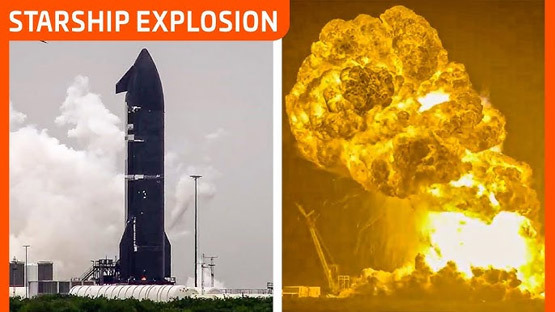
This year, SpaceX experienced three consecutive failures in test flights 7-9 conducted in January, March, and May, resulting in explosions or disintegration of the vehicle. On June 18, it was reported that during the self-test for the 10th test flight of Starship at the Starbase launch pad in Texas, an explosion occurred.
At that time, while charging cryogenic fuel for a 'static fire' test, which ignites six engines sequentially while the rocket is fixed to the launch pad, a sudden energy release caused an explosion and subsequent fire, according to SpaceX's explanation. The company reported that there were no injuries from the incident and confirmed that there was no danger to the surrounding area.
So, how much is the loss each time Starship explodes?
The estimated cost of a typical Starship launch is about $100 million. Of course, this estimate is based on recovery and reuse.
However, since the recovery success rate is still low, the direct loss from a single explosion is also considerable. Some analyses suggest that just the hardware loss, including the Super Heavy booster, the Starship itself, and the numerous sensors and electronic equipment onboard, amounts to about $30 million to $60 million. Including launch preparation, technical personnel, fuel costs, etc., the loss from a single explosion could be as high as $100 million.
However, ironically, Elon Musk views this loss as an 'investment.' What matters to him is "how quickly we learn."
In other words, instead of calculating for 10 years at a desk, it's about launching 10 times a year and accumulating data each time.
This is the biggest difference between the traditional aerospace industry and SpaceX.
The grammar of the aerospace industry we commonly know is "perfect verification → practical application," but SpaceX is the opposite.
"Let's build quickly, launch, and learn from it." This approach may feel unsettling to classical engineering minds.
But watching the repeated flights, I realized that engineering must ultimately be validated in practice, and there is no better textbook than what explodes in the field.
For my generation, who learned engineering through textbooks and calculations, the "applause after the explosion" of Starship may feel a bit strange, but now I understand. That it is the way of innovation. And when the first human truly sets foot on Mars someday, that moment stands on the many explosions and flight failures of today.
Now, every time Starship is launched, I clasp my hands and watch the broadcast screen. I do not expect an explosion. I am preparing to witness another advancement.
The dream of space is no longer just NASA's. It makes ordinary engineers like us dream again.
Someday, my junior may imagine becoming a 'Mars engineer.'
 WhenISeeHer






 novapixel |
 Peter Pan Pet |
 horse |
 Sunset Oregon |
 daisypat |
 Illinois Mom |
 Rice Shop Uncle BLOG |
 Khan Film Blog Production |
 Nanana Nanana Nanana |
 Enjoyable American Life Diary |
  manchester |
  constant |
  Leapfrog Move |
  vibranto |
  Tora Tora |
  yellowbutter |
  Dolly |
  US Embassy |
  NYC saladbar |
  Finding Superfoods |
  lightyear |
  song bang |
  vexomo |
  Indiana Jones |
  meloncat |
  mortrix |
  Esther 1983 |
  fortbliss |
  Moscow Kim |