
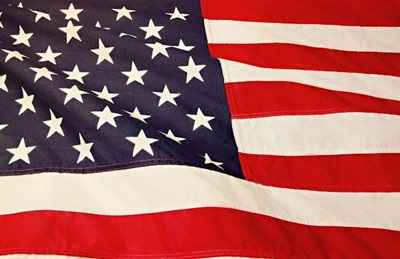
In the United States, the American flag (Stars and Stripes) is deeply respected as a national symbol, and that respect and protection is one of the core values of American society.
However, the First Amendment of the U.S. Constitution guarantees freedom of expression, leading to complex legal debates regarding the legal penalties for desecrating the flag in public places.
The First Amendment states, "Congress shall make no law respecting an establishment of religion, or prohibiting the free exercise thereof; or abridging the freedom of speech, or of the press; or the right of the people peaceably to assemble, and to petition the Government for a redress of grievances," thereby ensuring freedom of expression. This constitutional protection includes acts of burning or desecrating the flag, which are interpreted as part of freedom of expression.
In 1984, during the Republican National Convention in Dallas, Texas, a man named Gregory Johnson burned the American flag as a form of protest. As a result, he was sentenced to one year in prison and fined $2,000 under Texas law. However, on appeal, the state appellate court ruled that the state law punishing flag desecration violated the First Amendment, leading to a not guilty verdict. This case was escalated to the Supreme Court, which ruled 5-4 on June 21, 1989, in favor of Johnson, stating that flag desecration constitutes freedom of expression.
To strengthen penalties for flag desecration, several constitutional amendments have been proposed in Congress. However, these amendments have failed to pass in the Senate due to conflicts with the First Amendment's freedom of expression. For example, in 1995 and 2000, Senate votes resulted in defeats of 63 to 37.
Each state in the U.S. can independently decide whether to punish flag desecration and the severity of such punishments.
However, according to Supreme Court precedents, if flag desecration is deemed to fall under freedom of expression, the state law may be invalidated for violating the First Amendment. Therefore, penalties for flag desecration create a complex legal situation due to conflicts between state law and federal constitutional law.
There exists an unofficial guideline known as the Flag Code in the U.S., which contains recommendations for the respect and use of the American flag. However, the Flag Code is not legally binding, and violations do not result in legal penalties. Thus, penalties for flag desecration are determined by state laws and federal constitutional law, not the Flag Code.
As a country that values freedom of expression, the U.S. does not have laws punishing flag desecration. In contrast, countries like France have provisions for punishing flag desecration, imposing fines for desecration in private spaces and penalties or imprisonment for flag desecration at events organized by public institutions.
In the U.S., desecrating the American flag in public places falls under the freedom of expression protected by the First Amendment and is not punished at the federal level. However, the penalties and their severity may vary according to state laws, and the interpretation of federal and state laws is complex.
Therefore, the question of whether to punish flag desecration is determined by the interpretation of state laws and federal constitutional law, which remains a topic of ongoing discussion.






 newyorker 101 |
 Things to Do to Buy a House |
 U.S. Weather Bureau News |
 International Court |
 Eating Gukbap and Working Hard Deer |
  Burbank Lee |
  Olivia's Blog |
  Bushing Around Life |
  Active |
  Cherokee Rose |
  Kor. Master |
  Holey Moley |
  Conflite Teacher |
  Hodong Prince Over Flex |
  Mist inn |
  citrus pop |
  Onion Ring |
  phoenixia |
  viewtop |
  loverun |
  Kim Do Sun |
  SEVEN SEVEN |
  yentra |
  Make My Day |
  Victory 1988 |