

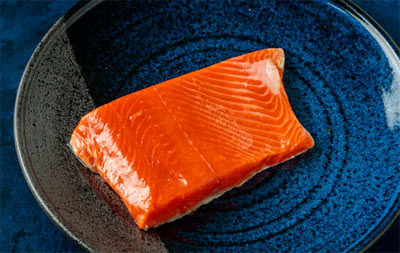
First, the king salmon, known as 'King Salmon,' is the king of salmon as its name suggests. It usually exceeds one meter in size, and if you're lucky, you can catch one larger than a person. Its flesh is very tender and has just the right amount of fat, melting in your mouth. This is why it is treated as a delicacy in high-end restaurants, and wild-caught ones are especially expensive. Among Alaska's fishermen and anglers, it is considered a 'fish worth bragging about' due to its strength and difficulty to catch. When fishing, it pulls the line with tremendous force, making it feel like a real tug-of-war in the water.
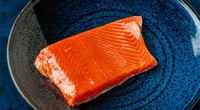
The sockeye salmon has a very vivid red flesh color. This is why it is called 'Red Salmon' in English. This salmon is born in rivers, goes out to sea, and then returns to the river where it was born to spawn after a few years. At this time, its body turns completely red, and the scene is truly beautiful. Therefore, the people of Alaska sometimes refer to this sight as the 'red parade created by nature.' Sockeye salmon is mainly eaten as steak or sashimi, and its flesh is firm, so it holds its shape well even when cooked. There is also a special sockeye salmon called 'Kokanee,' which lives only in rivers and is a rare type that never goes to the sea.
The silver salmon, as its name suggests, is a shimmering silver salmon. It is of medium size but has a very fierce temperament, making it a fish that anglers need to be particularly cautious of. It is known among fish as a 'fighter' due to its aggressive nature, making it quite challenging to catch. However, once caught and cooked, its flesh is tender and has a mild flavor, making it very popular. When grilled as a steak, the outside is slightly crispy while the inside remains moist, making it very delicious. This salmon also lives in the Great Lakes region, making it a special type that can be seen in the central United States.
The white salmon is especially loved in Japan. The Japanese call it 'Shirozake,' and it is often grilled with salt or made into salted salmon for breakfast. It is quite large, so one fish can feed the whole family. In the early stages of spawning, its body shines with a silver hue, leading anglers to call it a 'silver treasure.' In the past, this white salmon was the only type caught on the east coast of Korea, so when people said 'salmon,' they meant this species. In fact, in ancient times, people were so familiar with this fish that they referred to salmon as 'trout.'
Finally, the chum salmon, as its name suggests, has a male that develops a curly back during spawning, which is why it is also called 'humpback salmon.' It is smaller than other salmon but is the most commonly caught species in Alaska. Typically, it measures about 50 cm, so it is not large, but due to its high population, it is ideal for canning. Therefore, most of the 'canned salmon' we commonly see in stores is this chum salmon. Its taste is slightly mild and low in fat, but it pairs well with various dishes. It is especially popular when added to sandwiches or salads for its umami flavor.
Salmon is not just a simple food but an important presence that maintains the cycle of the Alaskan ecosystem.
Growing in the sea, returning to the river to spawn, and finishing its life, its body becomes nutrients for the river, sharing life with forest plants and animals. Wild animals like bears and eagles also thrive thanks to salmon, and people find jobs because of salmon. Therefore, in Alaska, salmon is referred to as 'a gift from nature.'




 AL ALASKA |
 Information on Area Codes in the Americas |
 Alaska Salmon Buyer |
 Sunny's Travel in America |
  Bushing Around Life |
  Active |
  Cherokee Rose |
  Kor. Master |
  Holey Moley |
  Conflite Teacher |
  Hodong Prince Over Flex |
  Mist inn |
  citrus pop |
  Onion Ring |
  phoenixia |
  viewtop |
  loverun |
  Kim Do Sun |
  SEVEN SEVEN |
  yentra |
  Make My Day |
  Victory 1988 |
  Tonky |
  viroma |