

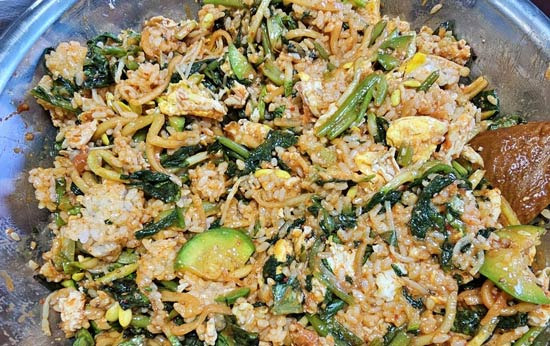
Putting a spoonful of gochujang into rice with a few side dishes and mixing it up is quite a peculiar act.
When rice and side dishes are separate, you eat moderately, but the moment you mix them together, suddenly the overeating mode is activated.
When you add a spoonful of gochujang to bibimbap, kimchi tuna mayo, or rice with soy sauce and butter sprinkled with seaweed, a bowl of rice that you usually eat disappears in an instant, and before you know it, you find yourself opening the rice cooker lid again.
Interestingly, the same goes for kimbap. Kimbap actually contains a lot of rice, but when you unroll and mix it, it feels like you're eating two or three times more rice than usual. Why is that?
The first reason is that the resistance of the food disappears the moment you mix it.
When you eat side dishes and rice separately, there is a process of chewing, selecting, and choosing. But when you mix it, all the ingredients blend uniformly, making it easier to scoop and swallow quickly. The density of a spoonful is high and the flavors are evenly distributed, making it hard for the brain to accurately gauge the amount of food consumed. You chew less, eat quickly, and since the feeling of fullness comes slowly, you end up eating more.
The second reason is that the concentration of flavors increases. When eating side dishes separately, some parts may be salty while others are mild, but mixing spreads the seasonings, oils, and spices throughout the rice, making each bite delicious. The brain signals you to eat more when the food is tasty. Especially when strong umami seasonings like gochujang, soy sauce, and sesame oil are involved, the effect is amplified. The harmonious and smooth flavor creates a 'taste you don't want to stop eating.'
The third reason is that the surface area of the rice grains increases, speeding up digestion.
When mixed, the rice grains separate more, and the seasonings coat them, allowing for faster digestion. When digestion happens quickly, the brain can easily be tricked into thinking 'there's still room to eat.' Kimbap is a prime example. The rice inside kimbap is compressed, but when you unroll and mix it, the volume increases, and the amount that goes into your mouth becomes ambiguously large. Originally, one roll of kimbap was enough, but when mixed, it becomes hard to calculate, "Is this one roll? Half a roll? A little more?"
The fourth reason is the illusion of 'not having eaten enough.' Mixed food has no distinct shape, making it difficult to visually assess the progress. When a piece of meat disappears, it's noticeable, but when a spoonful of bibimbap is gone, the bowl still looks full. Since it's hard to visually confirm the amount eaten, the brain doesn't feel full, and the spoon keeps moving. When you eat like crazy, you only realize you're full later, and regret sets in.
Finally, mixing activates the 'easy eating mode.' When eating separately, the actions are dispersed between rice, side dishes, and soup, but when mixed, you only need to focus on one bowl, putting the brain into automatic mode. You keep putting food in your mouth without stress, and especially when watching a drama or having YouTube on while eating, it becomes even riskier. Before you know it, you can easily surpass the fullness threshold and overeat.
In the end, the reason we overeat when mixing is not just because it's delicious, but because we eat quickly, the flavors are evenly enhanced, the feeling of fullness is delayed, and visually it feels like less food. So even if you promise yourself to only have "one bowl" of bibimbap or rice with seaweed, the bowl quickly empties, and you find yourself taking more rice out of the fridge.
The preventive measures are simply to eat slowly, set the amount of rice from the start, and take a break in between, which are very basic methods.
But to be honest, once you know the taste and convenience, can a person easily stop? The moment you mix, the game is already over.
Bibimbap is not just food; it's a trap, and mixing kimbap is like a slippery slide of calories.
So we mix again, and even while saying we're full, we scrape the bowl clean until the last spoonful.




 Bacon King Blog |
 Bald Eagle Brothers |
 Seattle - Emerald City |
 PETRO Vatican Shrine |
 Real Estate Agent USA |
  Tonky |
  viroma |
  cookie |
  Live and that's it |
  Alright Twain |
  eatontown blog |
  HAWAII Korean Church News |
  Amore |
  linex |
  Balancework |
  laro90 |
  MEDBIO American Doctor Blog |
  SWAT TEAM BLK |
  DREAM BIG |
  frostbite |
  330 Forever My Love |
  El Dorado |
  dralix58 |
  Gorama Round |
  Skydiving |