
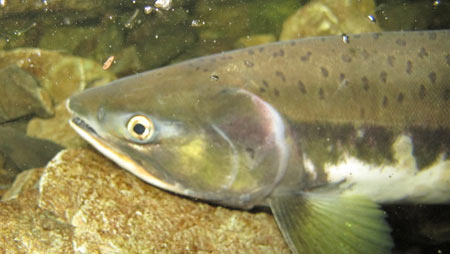
Alaska salmon plays an important role in the Alaska economy. In particular, king salmon generates approximately $85 million annually (about 107.6 billion won) through salmon fishing and processing in the southeastern coastal region of Alaska. There are five species of Alaska salmon (king, silver, red, pink, and chum), primarily inhabiting the cold temperate regions of the Northern and Southern Hemispheres.
The salmon we purchase for consumption is broadly categorized into Pacific and Atlantic salmon. Alaska salmon belongs to the Pacific salmon category and is widely distributed in the Pacific, Bering Sea, and Arctic regions from Northern California to Alaska. It is no exaggeration to say that Alaska is a paradise for salmon, boasting the largest natural salmon resource in the world.
Salmon belongs to the genus Oncorhynchus, derived from the Greek words "onco" and "rhino," meaning 'hook' and 'nose,' respectively, reflecting the fish's unique physical characteristics. Their scientific names were given based on indigenous languages encountered during Siberian explorations, showcasing the unique traits of each species.
Alaska salmon are anadromous fish, born in freshwater, growing in the sea, and returning to their birthplace to spawn. King, silver, and red salmon spawn in upstream rivers and lakes, while pink and chum salmon breed closer to the coast. During the spawning season, salmon do not eat at all, so they return to the rivers after accumulating sufficient fat and nutrients in the sea. The longer and more arduous the journey to spawn, the more energy the salmon will store.
Salmon fry born in rivers go out to the sea to grow, and when they become adults, they return to their birthplace to spawn upstream. Thanks to this unique migratory behavior, salmon serve as a bridge connecting marine and terrestrial ecosystems. Animals living in the forest, such as bears, foxes, and eagles, find salmon to be an excellent food source. Additionally, the carcasses and waste left by these animals after consuming salmon become natural fertilizers rich in minerals like phosphorus, enriching the forest. Salmon essentially act as nature's delivery service, bringing nutrients that have flowed into the sea back to the forest.
In particular, king salmon swimming upstream in the Yukon River undertake a challenging journey of up to 4,000 km to reach Teslin Lake at an elevation of 670 m. These salmon arrive still vigorous and nutrient-rich, showcasing the wonders of nature. Salmon occupy a crucial position in the food chain of both marine and freshwater ecosystems as apex predators. The carcasses of dead salmon after spawning provide nutrients to river ecosystems, aiding the growth of aquatic insects and plants. This, in turn, becomes a food source for young salmon, contributing to their survival and growth.
Alaska salmon is not only an important part of the natural ecosystem but also a highly valued ingredient worldwide. However, recent climate change, rising sea temperatures, and environmental pollution are causing a decline in salmon populations. This could negatively impact Alaska's salmon industry and local economy.







 Information on Area Codes in the Americas |
 Sunny's Travel in America |
 AL ALASKA |
 Omelet Rice for Strength |
 Tora Tora |
  yellowbutter |
  Dolly |
  US Embassy |
  NYC saladbar |
  Finding Superfoods |
  lightyear |
  song bang |
  vexomo |
  Indiana Jones |
  meloncat |
  novapixel |
  mortrix |
  Esther 1983 |
  fortbliss |
  Moscow Kim |
  My Two Way |
  toastyfox |
  FLORIDA Acus |
  tracker |