
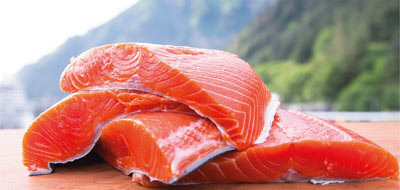
Alaska salmon are caught sustainably by utilizing their unique spawning habits. Salmon return to the rivers where they were born to spawn, and Alaska's fishery officials take this instinct into account when catching salmon. This process is carefully managed to ensure that a sufficient number of salmon can ascend the rivers to spawn, thus protecting the salmon resource. Additionally, salmon tend to move in dense schools in specific areas and rarely mix with other species, resulting in minimal bycatch.
Salmon fishing is only permitted in regulated areas within three nautical miles of the coast, and these fishing activities are strictly managed. Alaska fishermen primarily use small boats, most of which they own, allowing them to operate independently.
Trolling Method
Fishermen in Southeast Alaska are the first to start their work using the trolling method. Trolling involves dropping multiple fishing lines with bait or artificial lures from small boats to catch salmon. Although the catch is smaller compared to other fishing methods, the quality of the salmon is high. In particular, it targets pre-spawning salmon known as silver-bright salmon, which are considered the most vigorous and attractive fish in the sea.
The salmon caught by trolling mainly consist of king salmon, coho salmon, and pink salmon, accounting for less than 5% of Alaska's total salmon catch. However, they are highly valued for their superior quality and are traded at high prices. While the trolling method may seem inefficient, it adds significant value to the Alaska salmon industry by providing high-quality salmon.
Gillnetting Method
Gillnetting is one of the main methods of catching salmon in Alaska, capturing a significant amount of sockeye, coho, and pink salmon. This method involves setting a wall of nets in the salmon's migration path, guiding them into the net. Once the salmon enter the net, their gills get caught, preventing them from escaping. This method is simple yet effective and is widely used commercially.
Most gillnet boats are small vessels operated by one or two fishermen. The Alaska state government strictly regulates the size and equipment of fishing boats to manage fisheries effectively. Gillnet boats in Bristol Bay cannot exceed 32 feet in length. To keep the catch fresh, gillnet boats are equipped with ice holds or refrigerated seawater (RSW) systems. In high-catch areas like Bristol Bay, gillnet boats cannot process all their daily catch, so tenders transport the catch every few hours.
Most gillnet boats divide their holds into three or four compartments and use fabric "brailer bags". When a tender approaches the gillnet boat, the brailer bag is lifted onboard to transport the catch to the port. The gillnet boat then resumes its work. This system plays a crucial role in reducing handling time and maintaining quality.
Seine Method
The seine method is primarily used in Southeast, Central, and Western Alaska, as well as at the end of the Alaska Peninsula. However, it is not permitted in the northwestern part of the peninsula. Seine boats are generally larger than gillnet boats, but the Alaska state government limits their length to 58 feet. Despite these restrictions, seine boats can safely operate in the rough waters of fjords and straits due to their size.
Seines are circular nets with a closed bottom, effectively capturing schools of salmon. Salmon tend to move in large schools, and it is common to catch between 250 and 1,500 fish at once. Salmon have a tendency to jump to the surface while moving, allowing the entire crew to locate the salmon's position through this behavior.
Upon spotting a school of salmon, the seine boat immediately sets the net. When not using the net, the crew closely observes the sea surface to track the salmon's movements. The seine method effectively utilizes the schooling behavior of salmon, allowing for large-scale and efficient catches.
Seines enable large catches and are an important tool for managing salmon sustainably. Additionally, seine boats are designed to operate in Alaska's harsh natural environment, contributing to the stability and economic viability of local fisheries.





 AL ALASKA |
 Information on Area Codes in the Americas |

 Alaska Kim |
 Omelet Rice for Strength |
  dralix58 |
  Gorama Round |
  Skydiving |
  dreamport |
  Yellow Snowman |
  Toaster Pizza Magic Show |
  velvetnom |
  Anytime Journey |
  Mrs. Duluth |
  jaxter |
  Atlanta Mama |
  Baguette Blog |
  US Embassy |
  Korean Mom |
  My NYC |
  moo moo |
  Mr Oh |
  forevergee |
  festival |
  manchester |