

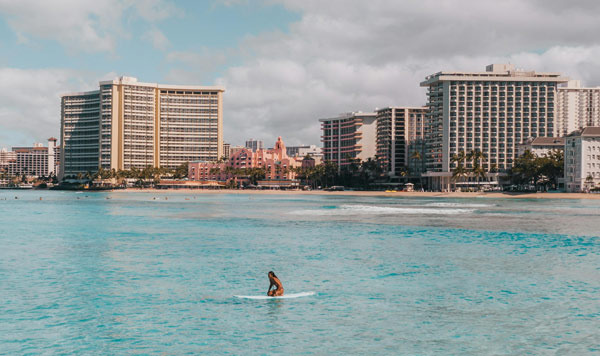
When listening to stories from mainland Americans who have retired and moved to Honolulu, there are common themes.
Initially, everyone talks about the great weather in Hawaii. With temperatures around 25 degrees Celsius year-round, there's no need to shovel snow or worry about a broken heater.
This is why many people from the East Coast, who want to escape the cold winters of places like California and New York, move to Hawaii.
However, as the conversation goes deeper, the narrative changes in a peculiar way.
When asked if Hawaii is a paradise as long as you have money, most people pause for a moment.
Then they add a condition: as long as you have a lot of money...
The amount referred to here is not an ambiguous figure.
It means being able to comfortably set aside $1 million to $2 million for a home.
Of course, it is also possible to retire with just a condo worth around $700,000 to $800,000.
Even if it's not oceanfront, a well-ventilated and well-maintained condo can provide a high level of satisfaction.
You don't need a car much, and there aren't many opportunities for big spending. By reducing dining out and eating at home, and making beach walks a daily routine, your expenses naturally decrease.
While having more assets does provide more comfortable options, Hawaii is a place where you can adjust your pace and live even with fewer resources.
The essence of retirement is not luxury, but sustainability.
When shopping at local markets here, anyone can find themselves pausing at the checkout.
The prices of milk, meat, and vegetables are all higher than on the mainland.
Dining out is even more expensive. If you imagined a life of eating out every day after retirement, you need to rethink that.
Ultimately, you end up cooking, and even while cooking, you find yourself calculating the cost of ingredients again.
The same goes for healthcare. Basic medical services are decent, but there are limited options for specialized care.
For more complicated treatments, you may end up needing to go back to the mainland.
Considering that health is the most important asset after retirement, this aspect can lead to deeper concerns.
Therefore, many mainland retirees who settle in Hawaii have sufficient funds.
They are people who don't worry about housing costs and can handle slightly higher living expenses without feeling a significant impact.
At this level, Hawaii definitely shows a different face. They avoid crowded tourist spots and enjoy the ocean in quiet neighborhoods as part of their daily lives.
This is not the Hawaii that tourists see, but the Hawaii that residents experience.
In the end, Hawaii is not a paradise for everyone. However, for retirees who don't have to worry about money, it certainly offers unique rewards.
A place where you don't have to live busily, where you don't have to calculate the seasons, and where the difference between today and tomorrow isn't significant.
In other words, if you lack money, the downsides become very apparent, while if you have enough, the downsides fade into the background.
So, retirees in Honolulu say with a smile today: living here isn't bad, but it's definitely not cheap.
 CheolYoungmi




 ultron78 |
 garlic bread |
 Sugar Cream Door Bulletproof Noodles |
 urbanmint |
 |
| 
 victoria 68 |
 TEX MEX STAR |
 Vacation on Hawaii |
 Hawaii Tourist Information |
 Korean Mom |
  My NYC |
  moo moo |
  Mr Oh |
  forevergee |
  festival |
  manchester |
  constant |
  Leapfrog Move |
  vibranto |
  Tora Tora |
  yellowbutter |
  Dolly |
  US Embassy |
  NYC saladbar |
  Finding Superfoods |
  lightyear |
  song bang |
  vexomo |
  Indiana Jones |