

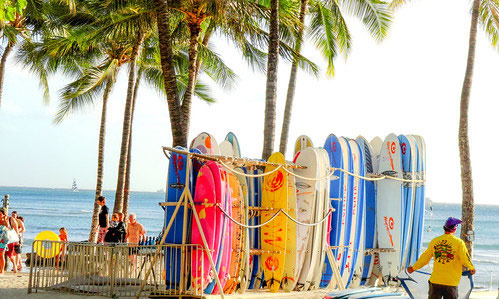
The beaches filled with palm trees, the emerald sea, and the endless laughter of travelers. When the economy is booming, Hawaii is paradise on earth. The influx of capital from around the world brings the islands to life, and hotels and restaurants are overwhelmed with guests. Cities that depend on tourism grow the fastest and most vibrantly when the economy is good. However, behind this glamour lies a massive trap. The moment the economy falters and the shadow of recession looms, the illusion of paradise shatters, and a harsh reality sets in.
About 23-24% of Hawaii's total state GDP comes directly from the tourism industry. When considering indirect effects, tourists essentially hold the lifeblood of the entire island. This distorted structure acts as a powerful growth engine during normal or prosperous times, but the moment there is even a slight crack in the global economy, it turns into its most fatal weakness.
History has repeatedly proven this harsh truth.
Three Years of Darkness: The Scars Left by 2008
The most painful memory dates back to the global financial crisis of 2008-2009. The fallout from the Lehman Brothers collapse that struck the mainland U.S. shook Hawaii to its core.
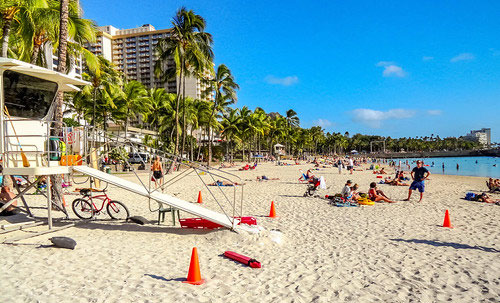
Sharp Decline in Visitors: In just one year, the number of visitors to Hawaii dropped by a staggering 1 million. Waikiki Beach became noticeably deserted, and the lights in luxury resort rooms were turned off one by one.
Evaporation of Capital: As tourists tightened their wallets, spending on the island evaporated by a whopping $3 billion.
Collapse of the Job Market: This shock directly impacted the livelihoods of local residents. The number of jobs that disappeared in an instant reached 43,850.
The scariest part was the 'time' after the shock. It took a staggering 3 years for the tourism ecosystem to recover to pre-crisis visitor levels, with relief only coming in 2012. The pain of unemployment and the weight of recession that Hawaii residents had to endure during those three years were beyond imagination.
Why a Tourism-Dependent Economy is Like a Sandcastle
Why does an economy reliant on tourism collapse so easily? Looking inside, there are two massive structural contradictions.
1. The Volatility of Discretionary Spending and the Trap of Fixed Costs
Tourism spending is purely discretionary consumption. In simple terms, it's money that isn't essential for survival. When a recession hits, households are the first to restructure their spending. No matter how bad the economy gets, people need to buy groceries and pay medical bills, but luxury cruise tickets or plane tickets to Hawaii can be postponed or canceled. Travel is the first area where global consumers feel the pinch.
On the other hand, the internal structure of Hawaii's economy is not flexible at all. Even if the number of tourists is cut in half, resort rental prices do not decrease. The costs of public infrastructure, such as electricity and water bills needed to maintain large hotels, and minimum labor costs remain as fixed costs.
As income approaches zero, expenses remain the same. In this brutal gap, the only option for small business owners and companies to survive is to resort to 'layoffs.'
2. A Single-Engine Economy Without a Buffer Zone
Another vulnerability of Hawaii's economy lies in the 'lack of industrial diversification.' The large-scale agricultural base that once supported Hawaii's economy, such as sugarcane and pineapple, has long been diminished due to global competition. Due to geographical constraints, large manufacturing plants cannot be operated. Ultimately, the two pillars responsible for the entire island's employment are the tourism industry and public jobs provided by the government.
A well-diversified economy can withstand downturns in the automotive industry while the IT sector holds strong, and manufacturing can falter while finance provides a buffer. However, an economy like Hawaii's, which is all-in on a single industry, has no defense. When the main engine of tourism comes to a halt, there is no 'Plan B' industry to absorb the surplus labor.
From Quantity to Quality, and Building a Breakwater
So, is the solution to artificially shrink the tourism industry? Of course not. Hawaii cannot abandon its natural environment, which is its greatest asset. The key is "how to grow alternative industries beyond tourism" and "how to use the massive profits earned from tourism as a buffer during crises."
Recent indicators show hints of the direction we need to take. The total number of visitors to Hawaii in 2025 saw a slight decrease compared to the previous year. By past standards, this would have triggered alarm bells as a sign of recession. However, surprisingly, overall tourism spending actually increased. This presents a new milestone for Hawaii's economy. The era of 'quantity tourism,' which brought in countless people through low-cost package tours while damaging nature and overloading infrastructure, is over. Now, Hawaii must shift its focus to 'quality tourism,' centered on high-value travelers who recognize its unique value and are willing to open their wallets.
At the same time, the tourism tax revenue and finances collected during prosperous times should not simply be consumed but should be saved as a 'national-level economic breakwater (sovereign fund or fiscal stabilization fund)' to withstand future global downturns. Additionally, mini-industries that can survive independently while synergizing with tourism, such as high-value tech industries and local cultural content industries, must be continuously incubated.
The beautiful waves of the Pacific always come and go. The same goes for the waves of the economy. It is wisdom not to be complacent when times are good, but to solidify the ground that will fill the void left when the waves recede. This is the most urgent task facing Hawaii and all tourist cities today.
 dream79
 Hot Tamale


 Smile Face |
 Helpful Life Stories |
 Casa Mia |
 Study Abroad Life Know-How Tips |
 pravix22 |
 HAWAII Korean Church News |
 TEX MEX STAR |
 Hawaii Tourist Information |
 Unknown Dog Walk blog |
 Vacation on Hawaii |
  Cap Com |
  nixxon |
  kevin Kim |
  beerdreamer |
  Kims Spring |
  White bunny |
  Kansas City Representative Singer |
  shadow 007 |
  sun walker |
  Choco Choco Star |
  midnight blue |
  honeypot |
  summer |
  adventure77 |
  flexible |
  Shintongbangtong Shin Naerin James Park |
  truepixel |
  Kathy's Blog |
  Hae Naem |
  quatspace |