
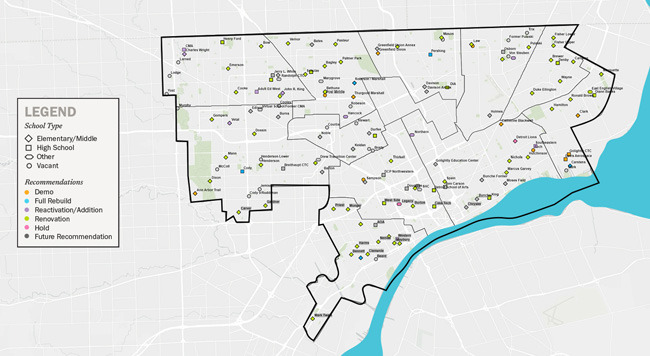
If you are living in or considering moving to Detroit, understanding the school district and property tax information is essential.
The Detroit Public Schools operate under the name DPSCD (Detroit Public Schools Community District), serving approximately 49,000 students across 107 schools.
Annual spending per student exceeds $15,000, which is above the Michigan state average, but overall academic achievement remains a challenging issue. In the past, a separate Recovery School District was operated by the state, but it has now been integrated into DPSCD.
Due to the difficulties within the Detroit public school system, many families opt for charter schools or Catholic and private schools. There are a significant number of charter schools in the Detroit area, some of which have high academic achievement and competitive enrollment.
Among Korean families, it is common to move to suburban areas with good school districts, such as Oakland County (Troy, Birmingham, Bloomfield Hills). The Troy School District and Birmingham School District are considered among the best in Michigan.
Property tax is an important tax that residents of Detroit must understand. In Michigan, property tax is calculated in 'millage' units. One mill means $1 for every $1,000 of taxable value. The total residential property tax millage in the city of Detroit is about 70 mills, which is among the highest in Michigan.
However, if a principal residence exemption (PRE) is applied, some school taxes are reduced, lowering the effective tax rate. Non-residential properties do not receive PRE benefits, resulting in a higher tax rate. Property taxes are billed in two installments: summer (July payment) and winter (December payment).
The total budget for the city of Detroit for FY2024 is approximately $2.6 billion. The largest expenditure items are the Detroit Police Department (DPD), Detroit Fire Department (DFD), and debt service due to past financial crises.
Public works, community development, and park management also account for a significant portion of the budget. Since the financial crisis, the city's finances have improved significantly, and bond credit ratings are recovering. Federal grants and Michigan state aid are also important sources of revenue for the city.
When purchasing a home in Detroit, it is crucial to check the history of property tax payments and any delinquencies. You can check the tax payment status on the Wayne County Treasurer's website using the address or parcel number.
Properties with delinquent property taxes may be subject to tax foreclosure, so caution is advised. Additionally, the city of Detroit operates a property tax relief program for low-income homeowners (Homeowners Property Exemption, HOPE), so it is worth checking the eligibility requirements. Those looking to acquire property in Detroit for the first time are strongly encouraged to consult with local real estate professionals or tax advisors.
 SkyDragon
 RubyHero
 LunaStarMan





 Round and Round Children's Song Kingdom |
 new sugar |
 Way to easy |
 Magic Cabbage School of Martial Arts |
 Vacation on Hawaii |
 juniper |
 amolayo |
 So is multiplied by So, So Ji-sub |
 U.S. Weather Bureau News |
 oflare |
 vivavida |
  limestone |
  oster |
  daddyyo |
  neapolis |
  seadoll |
  ansdal |
  Vivid U.S. Regional Information |
  Vasila's Newlywed Blog |
  Arizona Cowboy |
  merry merry |
  Hoorah Ooorah |
  Fragile Me |
  Rowland Mama |
  foxtree |
  bayaa |
  loveyom |
  Coastal city |
  Spaghetti Flying Religion |